After work, searching for SaaS investment takes you to two extreme camps: "AI is killing all SaaS" or "relax, earnings are fine." Both are partially right, but both are incomplete. Neither tells you which companies to actually own. So I built three criteria and filtered companies against them.
Criterion 1 — Is the Revenue Model Already Shifting? (Per-Seat → Usage · Outcome)
The problem with per-seat pricing is simple. If an AI agent does the work of five employees, a company has no reason to buy five seats. That's already happening. So the question isn't whether a company has AI features — it's how the company collects money.
Usage-based means you pay for what you consume. AI workload growth automatically drives revenue growth. Outcome-based goes further — you pay when the problem is actually solved. Few companies have fully adopted it, but the direction is clear. The share of companies using outcome-based pricing jumped from 2% to 18% in the span of a single quarter, and 37% of companies plan to change their pricing model within a year.
Snowflake is the most textbook example. Its entire model is consumption-based from the start. AI-related workloads are growing 3–4x faster than non-AI workloads — and because of its consumption pricing structure, every increase in customer AI usage flows directly into revenue. Salesforce is transitioning to outcome-based through Agentforce. Agentforce ARR grew 169% since launch, exceeding $800M, and closed over 29,000 deals. Datadog's monitoring infrastructure naturally captures more consumption as AI workloads grow.
Criterion 2 — Does Customer Data Accumulate Inside the Platform?
This is the core criterion.
A company that only sells features gets replaced by AI. A company where data accumulates becomes the foundation AI runs on. That difference is everything.
When customer data builds up inside a platform, two things happen. First, external AI agents can't access it. Second, the platform's AI outperforms generic models — a model trained on decades of customer behavior versus one starting from scratch isn't a fair comparison.
Snowflake satisfies this best. It runs AI inside the platform, without moving data out. Because AI agents and inference execute directly where governed data lives, there's no latency or security risk from data movement — and Snowflake collects revenue on that compute. Salesforce is accumulating 22 trillion records in Data Cloud — Data Cloud processed 22 trillion records in Q1 alone, up 175% year over year. That's not a storage product; it's the foundation Agentforce runs on. MongoDB is playing this role for the vector database layer. Developers building AI apps store and retrieve embedding data in MongoDB, and Atlas Vector Search supports the retrieval patterns that models like GPT-4 require. MCP server support lets AI agents understand database schemas and query directly. ServiceNow plays differently — decades of enterprise workflow data have accumulated, and Now Assist runs on top of it. Even if AI tells the workflow what to do, ServiceNow is the one that executes it on legacy systems.
Criterion 3 — Do Actual Quarterly Results Justify the Stock Decline?
The third criterion is the numbers. Whether a decline is narrative-driven fear or real earnings damage is something only filings can confirm.
When SaaS stocks collapsed earlier this year, actual results often told a completely different story. Datadog Q1 2026 revenue grew 32% year over year to $1.006B; customers with $100K+ ARR grew 21% to 4,550. The stock fell but the earnings trajectory pointed opposite. ServiceNow Q1 2026 subscription revenue grew 22% year over year; cRPO grew 22.5% to $12.6B. Snowflake Q4 product revenue grew 30%, RPO grew 42%, and NRR of 125% means existing customers are spending 25% more than a year ago. MongoDB Atlas revenue grew 30% year over year, with Atlas now representing 75% of total revenue. Salesforce FY2026 total revenue of $41.5B grew 10% year over year, with RPO up 14%.
The pattern: stocks fell, but RPO, NRR, and ARR all rose. RPO is already-contracted future revenue. NRR of 125% means existing customers are expanding. The earnings data does not justify the stock decline.
The Financials — GAAP Operating Income for Four Companies
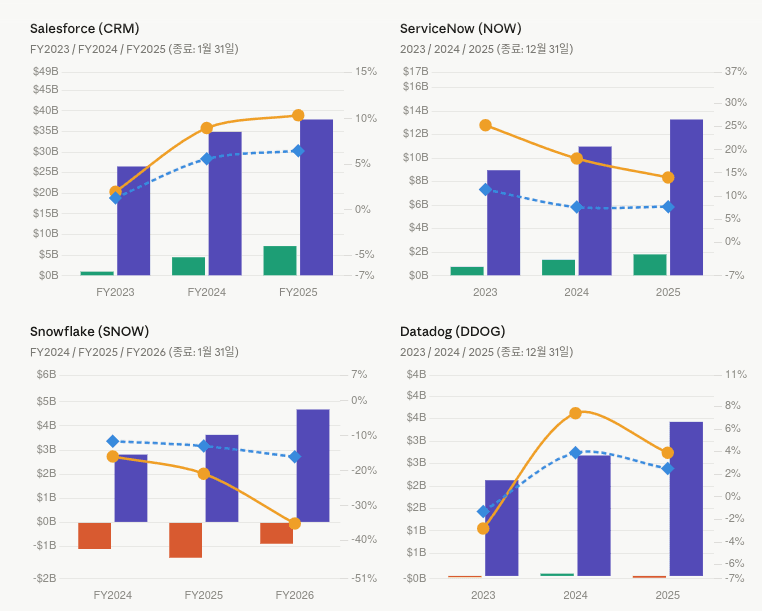
Salesforce — The most dramatic margin recovery in the group. From $1.0B GAAP operating income in FY2023 to $7.2B in FY2025, a 7x increase in three years. The 2023 restructuring (10% workforce reduction) began flowing directly into margins from FY2024. Revenue growth has slowed, but the profitability inflection is unambiguous.
ServiceNow — The most stable trajectory of the four. Revenue and operating income grow together — a classic mature-platform profile. GAAP operating margin has held consistently at 13–14% while maintaining growth.
Snowflake — Revenue is growing rapidly but GAAP operating income is negative across all three years. Operating losses peaked in FY2025 (–$1.46B) and are now compressing toward –$0.88B in FY2026. On a non-GAAP basis, operating margin has crossed 10%. Stock-based compensation is the key distortion — it drags reported earnings far below business-level economics.
Datadog — Smallest in absolute scale but fastest-growing. GAAP operating income oscillates near breakeven. Like Snowflake, SBC is heavy enough to make GAAP results look like losses when the non-GAAP operating margin is above 20%.
The gap between GAAP and non-GAAP matters most for Snowflake and Datadog. Both carry stock-based compensation in the hundreds of millions annually — reading GAAP operating income alone significantly understates the underlying business health of both companies.