I sketched out a 25-year asset plan after work. It felt like a joke at first, but once I broke it down year by year, my thinking actually clarified. Designing a 2050 investment plan today can sound far-fetched — until you remember that the people who got rich in the gold rush weren't the ones panning for gold. They were the ones selling pickaxes.
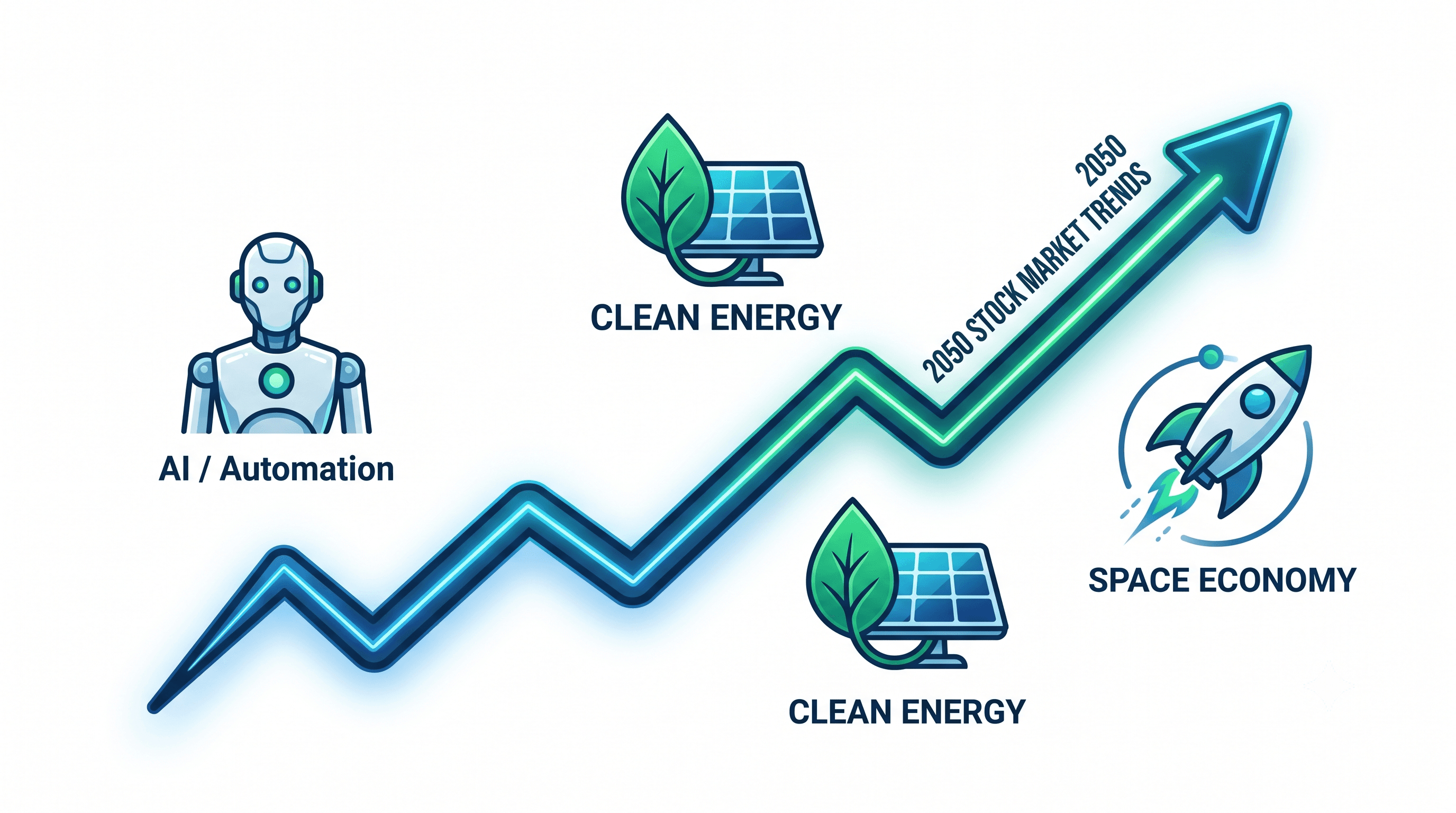
Why a Pickaxe — the Bottleneck of the Physical AI Era
Predicting 25 years straight through is impossible. Instead, I approached each segment by asking: where is the bottleneck money is forced to flow toward? As AI spreads beyond software into robotics, autonomous driving, and manufacturing — the physical AI era — the bottleneck is power and compute.
Here's why that matters: a bottleneck means no competition. Hundreds of AI service companies compete with each other, but the data centers and semiconductors they all depend on for power are concentrated in a handful of players. That's the structure where you can win without ever having to pick the winner.
So for 2026–2030, I put 60% into power and semiconductors. Robotics components get only 15% for now — a seed planted early, waiting for the next cycle.
A Cycle Is a Game of Switching Tools
The location of the bottleneck shifts every five years. From 2031–2035, I raise robotics components and RaaS (Robotics-as-a-Service) to 35%, then from 2036 onward shift back toward indices and dividends. The common mistake here is holding onto a theme that's already had its run, all the way to the end.
The pickaxe of one cycle often becomes the baggage of the next. That's why money made in power and semiconductors through 2030 moves into robotics components starting 2031, then back into indices from 2036 — because the bottleneck isn't fixed, it moves.
So I built one rebalancing rule into the plan: touch it once a year, at year-end, and nowhere else. The moment a theme becomes a news headline, it's already too late to be an entry point.
The Real Alpha Isn't the Allocation Table — It's the Field
The 2031–2035 window — when robots penetrate manufacturing, logistics, and construction — is personally the segment I'm watching most closely. Working on robotics adoption at construction sites, I see certain information as purchase orders before it ever shows up in a report.
I think that matters more than the allocation percentage itself. Putting the same 35% into robotics components means something completely different depending on whether you know which company's reducer is actually going into the field first, versus finding out from the news.
So for this window I set a separate trigger: "once three or more industries confirm ROI reaching break-even against labor cost, expand the allocation to its upper bound." It's a mechanism meant to respond to confirmed signals, not gut feeling.
What the Numbers Confirm — What 200 Million Won Becomes by 2050
Running the simulation from an initial 200 million won: the conservative 7%-a-year scenario lands around 1 billion won, the base 10%-a-year scenario around 2 billion won, and the aggressive 13%-a-year scenario around 3.8 billion won. Sustaining 13% annually for 25 straight years, though, is something only a tiny handful of investors have historically pulled off — so that number should be treated strictly as an upper bound, not an expectation.
What I actually confirmed here is that principles drive the outcome more than the return rate does. Just three rules — a 10% cap on any single position, always holding 10% in cash, and never entering a theme after it's become news — accounted for most of the gap between scenarios.
I also checked that, stripped of inflation, the real purchasing power of 2 billion won is closer to 1.1 billion won in today's money. The number looks big, but when you're building a plan, you have to think in real terms, not nominal ones.
Summary
What this 25-year exercise taught me is that what I'm actually trying to get right isn't the future — it's the principles. If I reread this in five years, half of it will probably be wrong. But as long as what remains is finding the bottleneck, switching tools every cycle, and getting in before it becomes news, that's enough for a 2050 investment plan.
This post is for informational purposes only and does not constitute a recommendation to buy or sell any specific security. All investment decisions and their outcomes remain the sole responsibility of the investor.