When news broke that Michael Burry had taken a short position on Palantir, reactions split cleanly in two: "See, it was a bubble all along" and "Burry has been wrong before." I went back and looked at Palantir properly. The short answer: Burry's concern isn't wrong, but it isn't the whole picture either.
Bull vs. Bear: What's Actually Different
When you look at where the two sides clash, they're often reading the same numbers and reaching opposite conclusions.
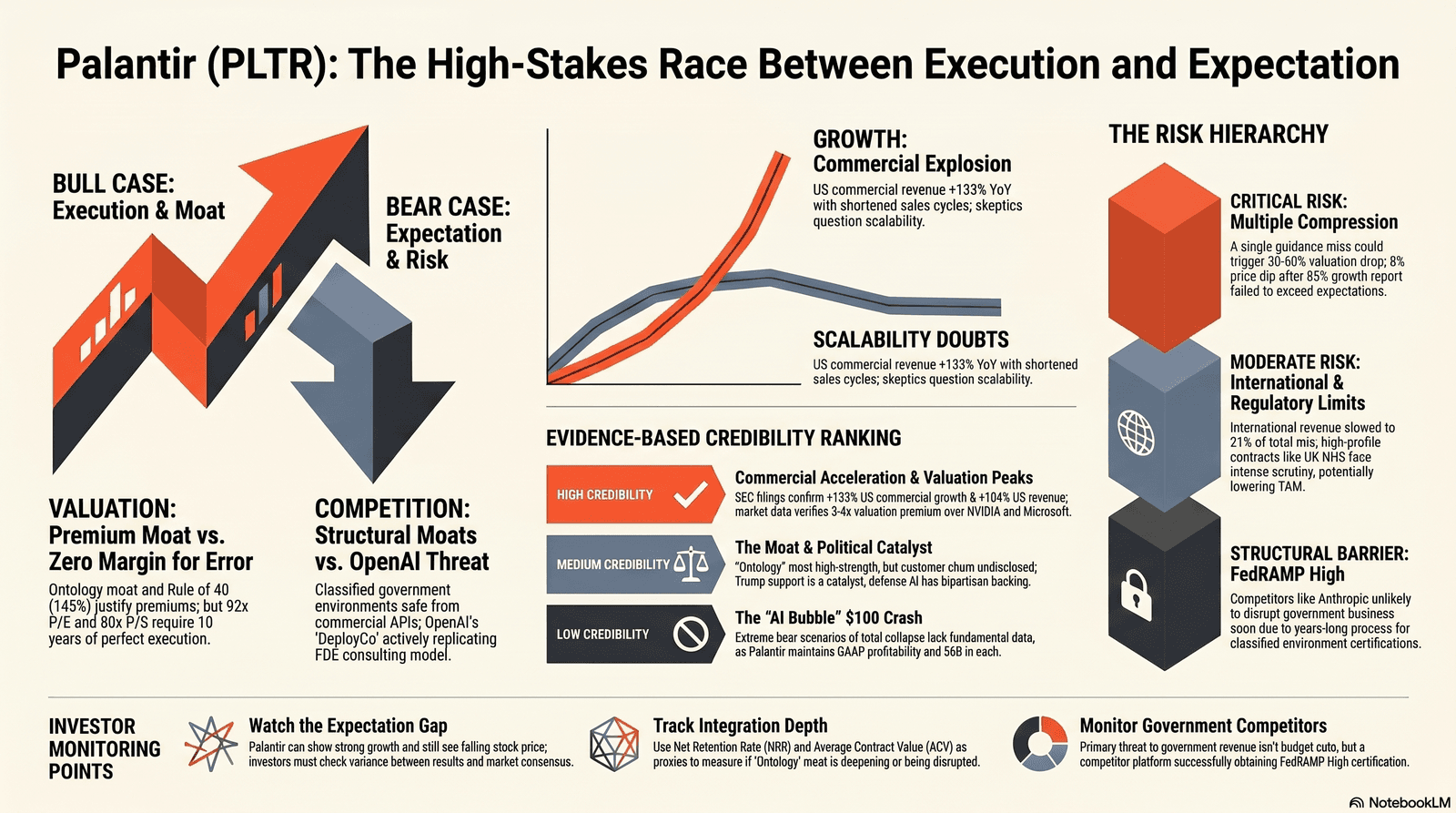
The bull case: US commercial revenue grew 133% year-over-year, government revenue 84%. GAAP operating margin is 41%. Very few software companies achieve that combination of growth and profitability simultaneously. Rule of 40 cleared 145%, and free cash flow margin is at historically high levels. Palantir is embedded deep in the US defense budget, and a $10 billion Army contract has landed.
The bear case fires back at those same numbers. Forward P/E is 92x, P/S is 80x — three to four times the premium of Nvidia or Microsoft. That price already bakes in five to ten years of flawless execution. Even a small miss versus expectations could produce a 30–50% drawdown with no change in fundamentals.
Both cases are data-driven, which is exactly what makes this hard.
Is the Ontology Moat Real? — The AI Competition Threat
The core of the Palantir bull thesis is the Ontology. In short: it's a structured representation of a company's data and workflows — a kind of organizational digital twin — built so AI can actually act on it. Not just connecting spreadsheets, but rewriting how business processes are understood in machine-readable terms.
Once built, it's hard to rip out. Years of operational data and decision patterns get encoded into the Ontology, and the cost of leaving exceeds the cost of staying.
The problem is OpenAI has entered with a similar FDE (Federated Data Environment) strategy under the name DeployCo. LLM inference costs are dropping fast, which lowers barriers to entry. Classified government environments are protected for now — FedRAMP High certification is a hard gate. But in the commercial market, competition is running today.
The moat is real. How deep it is depends on NRR and commercial ACV trends. If those start bending, it means the replication threat is becoming real.
Are Government Contracts Actually Safe? — Pentagon AI Contract Analysis
The clearest differentiation Palantir has from other AI companies is its government revenue weight. Q1 US government revenue was $687M, up 84% year-over-year. There's a $10B Army contract and Trump's public endorsement.
But the bear side flags something real here. Government contracts contain "termination for convenience" clauses — the government can exit at will. That makes Remaining Performance Obligation (RPO) figures less predictive than they look.
Realistically, support for defense AI is bipartisan. Whether Trump or the next administration, the US military is not going to walk back AI-enabled warfare. The actual risk isn't budget cuts — it's whether a competing platform earns FedRAMP High certification. Until that happens, the government moat holds.
How to Read the Valuation — Standards for High-Multiple Growth Stocks
This is the most contested part. P/E 92x, P/S 80x. On the surface, excessive.
But judging whether this price is excessive by looking at the multiple alone is the wrong frame. The right question is: how fast does the gap between priced-in expectations and reality close?
Q1 2026 results showed 85% year-over-year growth and the stock fell 8%. Not because growth was bad — because the market had priced in something higher. That's the kind of stock Palantir is. Good absolute numbers can still produce a down day. The bar is "how much did you beat expectations," not "what was your growth rate."
At P/E 92x, the stock requires roughly 30%+ average annual growth for the next five years. That's a plausible scenario. But the margin for error is zero. One quarter where guidance comes in below consensus triggers 30–50% multiple compression with no change to the underlying business.
What to Worry About, and What Not To
The risk tiers break down clearly.
Real concerns: Multiple compression triggers, OpenAI DeployCo eating into commercial customers, SBC dilution. All three are measurable within six to twelve months.
Worth watching, not panicking over: Trump political risk, international regulatory exposure, broad AI spending slowdown. Real influence, but government contracts provide a buffer.
Not worth worrying about: The "AI bubble collapse sends stock to $100" scenario. Palantir is GAAP-profitable with $6 billion in cash. It does not belong in the same bucket as speculative names. Anthropic penetrating classified government environments in the short term is structurally implausible.
So What Do You Do With This Stock?
This isn't about whether to buy or sell. But if you're invested, certain habits matter: check market consensus before each earnings print. Monitor NRR and commercial ACV per customer to read the moat's condition.
It's a good business. The question is how much of that is already in the price. The core trade is watching how fast — or whether — the gap between expectations and reality closes.
Bulls and bears are ultimately looking at the same question: can Palantir grow into its own expectations?
#Palantir #PLTR #PalantirStock #AIStocks #USStocks #GrowthInvesting #DefenseAI #Ontology
Investment Disclaimer: This post is for informational purposes only and does not constitute investment advice. All investment decisions and their outcomes are the sole responsibility of the reader. Nothing in this post should be construed as a recommendation to buy or sell any specific security.