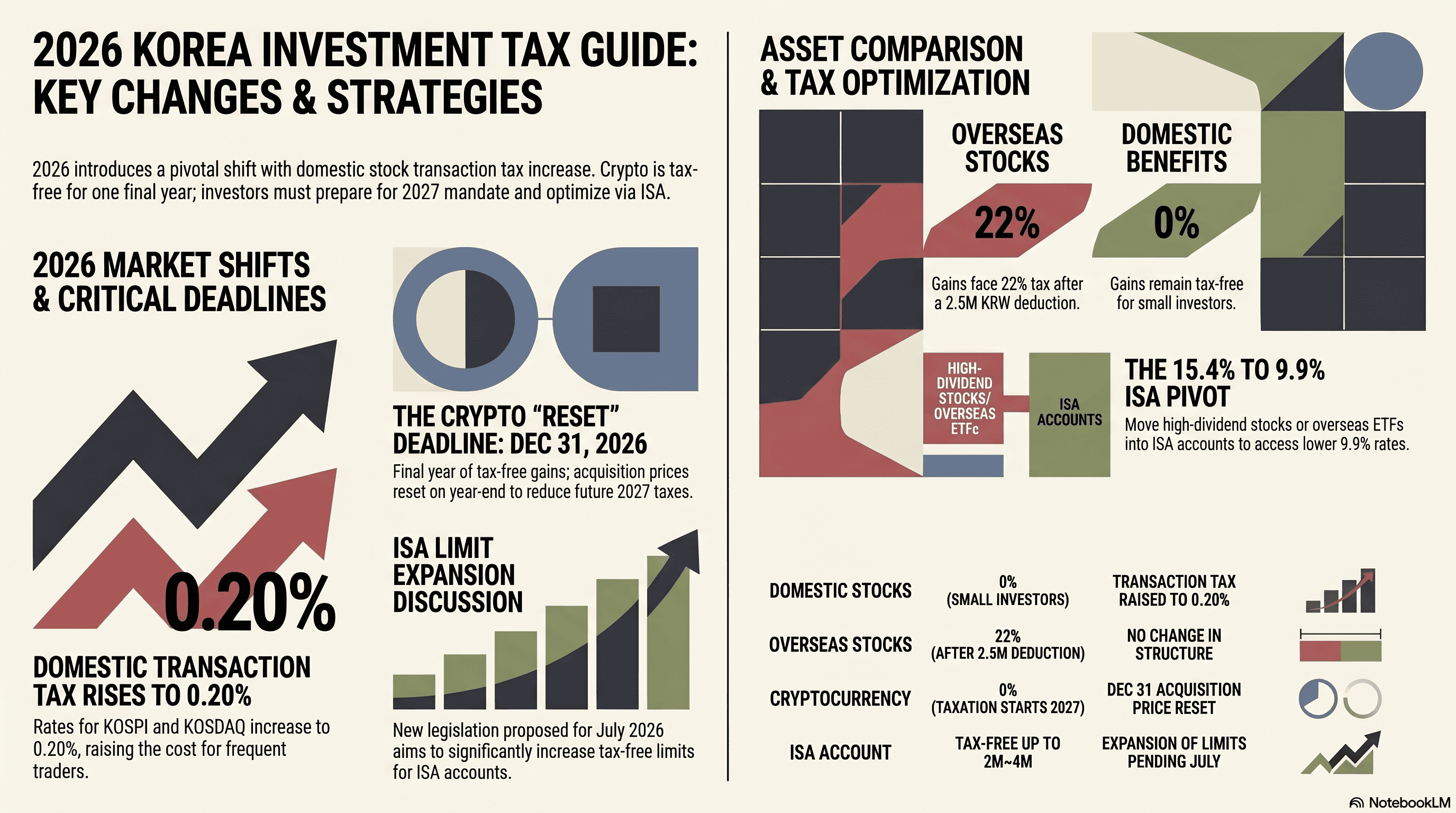
I'd been hearing vaguely that the securities transaction tax changed earlier this year, so I dug into the details and ended up mapping out all of it. Stock, crypto, and ISA tax structures shifted meaningfully in 2026 — and for crypto in particular, there's something you need to check before year-end.
Domestic Stock Transaction Tax Hike — Frequent Traders Will Feel It
Starting January 2026, Korea's KOSPI securities transaction tax rose from 0.15% to 0.20%. KOSDAQ followed the same increase. It sounds like a small 0.05 percentage point difference, but for active traders the cumulative burden adds up.
The previous policy trajectory had been steadily lowering transaction taxes when the capital gains tax (금투세) was abolished. This reverses that trend — instead of a capital gains tax, transaction taxes went up. Capital gains tax still only applies to major shareholders (holders of 50 billion won or more in a single stock). Small investors still pay zero capital gains on domestic stock trades. The 15.4% dividend withholding rate is unchanged.
Practical impact: on a 10 million won buy-and-sell cycle, the transaction tax alone is 20,000 won. If you're turning over your portfolio multiple times a month, that compounds significantly over a year. Long-term holding is now more tax-efficient than before.
Foreign Stocks — Structure Unchanged, Tax Optimization Still Works
Nothing changed for foreign stocks in 2026. The setup remains: deduct 2.5 million won from annual capital gains, pay 22% on whatever remains. Dividends: 15.4%.
The key point is that you need to file yourself. There's no withholding at source, so you must file during the May comprehensive income tax period each year. If gains are under 2.5 million won, there's no penalty for not filing.
Tax optimization is straightforward. Don't sell all your gains in one year — spread realizations across multiple years to use the 2.5 million won deduction repeatedly. If you have losing positions, consider closing them in the same year to offset against gains.
Crypto Taxation — 2026 Is the Last Tax-Free Year. Check Before Year-End
As of 2026, cryptocurrency gains are still tax-free. Taxation is scheduled to begin January 2027, and the National Tax Service has indicated it's in the final preparation stages. A fourth postponement isn't completely impossible, but planning nothing while hoping for a delay is risky.
From 2027, gains from crypto trading or lending will be classified as "other income" — 2.5 million won annual deduction, then 22% tax rate applies.
What you need to check before year-end 2026: the deemed acquisition price rule. The higher of your actual purchase price or the market price on December 31, 2026, will be recognized as your acquisition cost for tax purposes going forward. In plain terms: if you bought Bitcoin in 2023 at 30 million won and it's worth 100 million won at year-end 2026, your taxable base from 2027 onwards resets to 100 million won. The gains that accumulated before that point are untaxed.
Know exactly when and at what price you acquired your holdings, and track what the year-end market price turns out to be. If "when did I buy this?" becomes fuzzy later, you lose the tax benefit.
ISA Accounts — If You Don't Have One, Open It Now
ISA benefits are unchanged in 2026. Gains up to 2 million won are tax-free; above that, a separate flat 9.9% tax applies. If your annual income is under 50 million won, the tax-free threshold rises to 4 million won under the standard household account type.
Two core reasons ISA is advantageous:
First, loss offsetting. If you gain 2 million won on asset A and lose 1 million won on asset B inside the same ISA, only 1 million won is taxable. With a regular brokerage account, every gain is taxed individually. Wrap overseas ETFs in an ISA and the netting applies.
Second, the flat tax keeps you out of comprehensive income tax trouble. Financial income over 20 million won normally triggers combined income taxation with higher marginal rates. ISA returns are excluded from that calculation.
Note: you can't hold foreign stocks directly in an ISA. Domestic-listed overseas ETFs (like TIGER S&P500) are permitted. The tax advantage is greatest for assets that would otherwise generate taxable gains — domestic stocks are already capital-gains-free, so the ISA benefit there is mainly on dividends.
There's an active discussion about expanding ISA limits in 2026. The proposal under review would raise the tax-free threshold to 5 million won, and to 10 million won for accounts invested only in domestic stocks and funds. The framework is expected to be clearer after the July tax law revision. If you don't have an ISA yet, open one now and start accumulating the 20 million won annual contribution limit.
2026: When Tax Changes, Strategy Changes Too
The transaction tax hike raised the cost of frequent trading. Crypto has a December 31, 2026 deemed acquisition price reset ahead of 2027 taxation. ISA limit expansion is under discussion. The foreign stock tax structure is unchanged.
Tax is as important a variable as returns. What matters is not how much you earn, but how much you keep after taxes. Now is a good time to assess where your portfolio is leaking the most to taxes.
This article is for general informational purposes and does not constitute professional tax or legal advice. Tax treatment varies by individual circumstances — consult a qualified tax professional for your specific situation.