Premise: This Is Structural Analysis, Not Prediction
Predicting "which stocks will rise" in 2040–2050 is impossible. What we can do instead — following Goodhart's logic — is identify areas where structural demand will grow while supply remains constrained. That's what this analysis maps out.
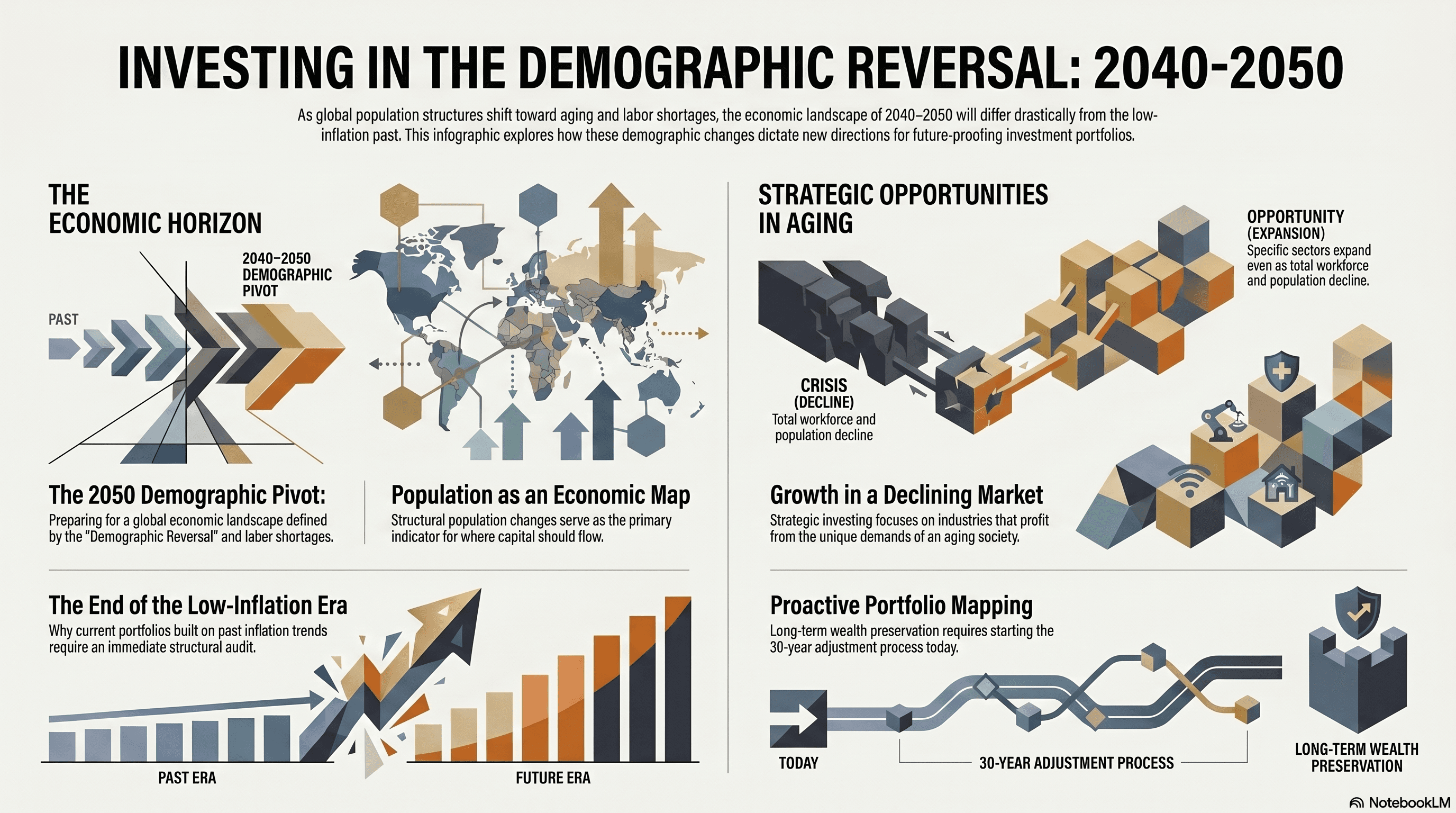
2030–2040: When Demographic Pressure Hits Full Force
Three areas face the most direct pressure in this period.
① Senior Care and Eldercare Infrastructure
This is the darkest chapter Goodhart writes. By 2050, the global population aged 60+ will reach 2.1 billion — double the 2020 figure. In South Korea alone, those 65 and older are projected to exceed 40% of the population by 2050.
Demand explodes, but supply can't keep up. Caregiving is hard to automate, takes time to train, and pays poorly — all of which structurally push up the price of care services.
Two investment directions follow. First, senior housing REITs — Welltower (WELL) and Ventas (VTR) are the archetypes. They operate nursing facilities and independent living communities; both occupancy rates and rents rise together. Second, care robotics and medical devices — not replacing caregivers entirely, but augmenting them. Intuitive Surgical (surgical robotics) fits here; in Korea, Angel Robotics (rehabilitation exoskeletons) points in the same direction.
② Automation and Industrial Robotics
When the labor pool shrinks, companies face two choices: raise wages or replace workers with machines. Goodhart acknowledges automation can partially offset demographic decline — which also means automation demand is structurally elevated.
This goes well beyond factory floors. Logistics, food service, cleaning, agriculture — all low-wage, labor-intensive industries — will see automation ROI improve as labor grows scarce.
The relevant plays: Fanuc (industrial robots), Keyence (sensors and automation equipment), and globally, BOTZ (Global X Robotics & AI ETF) or ROBO ETF.
③ Inflation-Hedging Assets
If Goodhart's central thesis — structural inflation — holds, assets with fixed nominal value lose real purchasing power. Cash and long-duration bonds are the clearest examples.
Assets that rise with inflation become structurally advantaged:
- Gold: The classic hedge against inflation and dollar weakness. As fiscal deficits deepen and bond issuance grows, gold's relative appeal increases.
- TIPS (Treasury Inflation-Protected Securities): Principal tied to CPI. Real returns are preserved as inflation rises. ETF options: SCHP, TIP.
- Infrastructure REITs: Many have leases with inflation-linked rent escalators — cell towers, logistics warehouses, data centers. American Tower and Prologis are the leading names.
2040–2050: When Fiscal Pressure Goes Structural
Goodhart's loudest warning for this period is the full arrival of fiscal stress.
ECB analysis projects eurozone government spending to reach 27% of GDP by 2040 — the exact moment when the Boomer generation begins drawing heavily on pensions and healthcare. Raising taxes is politically untenable; bond issuance keeps growing.
Two directions to watch in this phase:
① Long-Duration Bonds Face a Structural Headwind
Supply grows (governments keep issuing) while the pool of savers who absorb it shrinks. Goodhart's steepening yield curve becomes more pronounced here. Holding long-term government bonds as a portfolio cornerstone carries significant structural risk in this scenario.
② Energy Infrastructure as a Structural Beneficiary
As deglobalization and reshoring proceed, countries must secure domestic energy supply. Add AI data center power demand on top. Investment needs in power grids, nuclear, and LNG infrastructure persist through 2040–2050. In Korea: Doosan Enerbility, HD Hyundai Electric. Globally: Cameco (uranium), NextEra Energy (renewable infrastructure).
Structural Headwinds to Avoid
The flip side of the opportunity map matters equally.
Assets optimized for low-rate environments face structural pressure: high-growth tech stocks whose valuations depend on low discount rates; real estate in shrinking-population regions; and the long-duration bonds already discussed. This isn't an immediate collapse scenario — it's a gradual, structurally-driven compression that intensifies as the demographic shift becomes undeniable.
The One Wild Card: Can AI Change This Scenario?
In 2020, Goodhart argued AI and automation were insufficient to offset labor shortfall. By 2025, AI's pace has clearly outrun his estimate.
This is the variable with the power to fundamentally alter the script. If AI raises productivity enough to offset declining headcounts, inflation pressure may be materially less than the demographic argument implies.
Current evidence: AI is lifting productivity. Whether the magnitude and speed are sufficient to fully offset demographic decline remains genuinely uncertain. Goodhart's structural framework remains valid, but AI's pace is the key variable determining how intense the reversal actually becomes.
Summary
| Period | Core Pressure | Beneficiaries | Headwinds |
|---|---|---|---|
| 2030–2040 | Labor scarcity, eldercare surge | Senior REITs, automation/robotics, TIPS, gold | Long bonds, shrinking-population real estate |
| 2040–2050 | Fiscal deficits, energy demand | Energy infrastructure, commodities, infra REITs | High-growth tech valuations, long bonds |
The approach: identify structurally demand-advantaged areas first, then find the best executors within them. 2040 may feel distant, but the demographic shift driving it is already underway.
※ This analysis is based on Charles Goodhart's demographic reversal framework and does not constitute a recommendation to buy any specific security. Final investment decisions are your own responsibility.