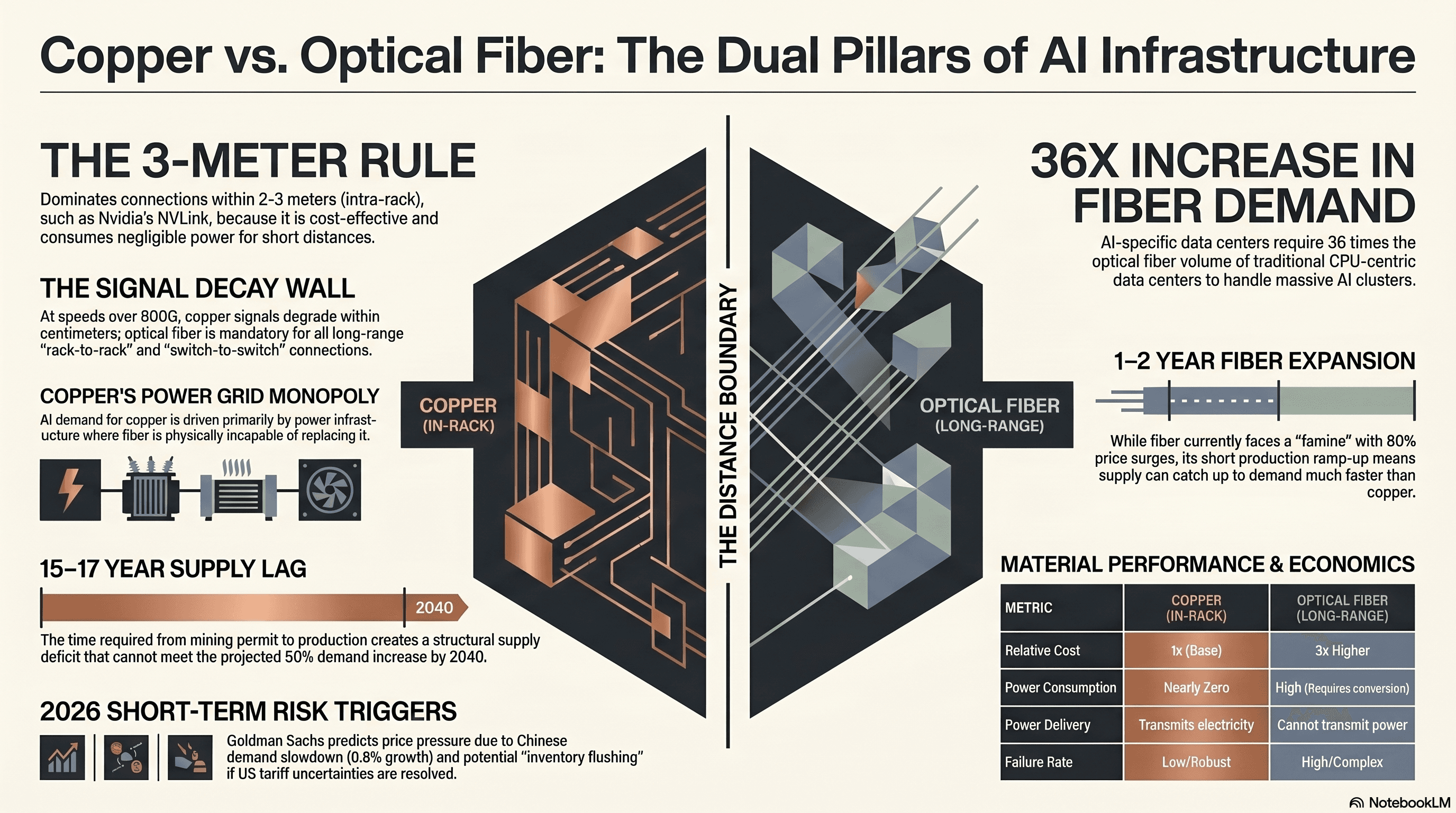
Whenever I browse AI data center materials stocks these days, I keep hearing the same thing: "Copper is going to get squeezed out by fiber optic." Every time I hear it, something feels off. The deeper I dig into the data, the clearer it becomes — this frame is wrong from the very start. Copper and optical fiber don't compete. They operate in different layers.
What Copper and Optical Fiber Actually Do Inside an AI Data Center
Most people think "data center = fiber optic." But in reality, the two materials are split by one variable: distance.
Short-range connections inside a rack — within 2–3 meters, where GPUs sit close together — are dominated by copper. Power consumption is near zero, and cost is one-third that of optical fiber. Nvidia's NVLink uses copper for intra-rack connections of up to 2 meters. But when you need to push 800G+ signals over long distances, copper hits a hard physical wall. Signal attenuation begins within centimeters. That's electromagnetic physics — not something marketing or engineering can overcome.
Optical fiber fills everything beyond that wall. As AI clusters grow, inter-rack and switch-to-switch connections multiply explosively. Some estimates put AI data center optical fiber consumption at 36 times that of traditional CPU-centric racks.
The conclusion is simple: as data centers grow, they need more copper for power and more optical fiber for data. Both, simultaneously.
What Actually Drives Copper Demand — It's Not the Data Center
Here's where most people get confused. The logic goes: "If fiber optic takes over the AI era, copper demand will fall." But the copper used for data transmission inside data centers is a tiny fraction of total copper demand.
The real copper demand driver is the power grid. Transformers, busbars, cooling plates, grounding systems — none of this can be physically replaced by optical fiber. Electricity doesn't flow through glass fibers. The power infrastructure alone for a single AI data center building consumes substantial copper, and on top of that, grid expansion, renewable energy connections, and EV charging infrastructure are all simultaneously pulling copper demand higher.
The IEA and S&P Global project copper demand will rise 50% by 2040 from current levels. On the supply side, it takes 15–17 years from mining permit to production start. Even if mine development began right now, meeting 2040 demand would be a stretch.
Why Short-Term Prices Are Volatile — China and Tariffs
That said, will copper prices rise right now? That's a different question.
Goldman Sachs projects copper prices could fall to $11,000 per ton by end of 2026. Visible inventories alone stand at 1.5 million tons, with a potential surplus of up to 600,000 tons expected in 2025. China's copper consumption growth rate is forecast to plunge to 0.8% in 2026, and actual orders for copper rods and tubes are already declining year-over-year.
Then there's the tariff wildcard. Large-scale pre-stockpiling in the US ahead of tariff implementation means that if tariffs are confirmed or exempted, that inventory could flood the market all at once. The core trigger Goldman cites for its downside scenario is exactly this inventory distortion unwinding.
Bottom line: copper has a solid long-term structural story, but near-term prices are governed by China demand and tariff events. Holding a long-term position while short-term events shake the price — that's the essence of copper investing right now.
Optical Fiber Is Tight Right Now — But Don't Get Confused
The optical fiber story is different. Right now, supply is not keeping up with demand. The phrase "2026 fiber famine" is being used openly in the industry. Chinese-made optical fiber prices surged 80% in three months. Corning's enterprise revenue grew 58%.
Near-term supply is this tight because AI data center order speed is outpacing supply capacity. When CPO (Co-Packaged Optics) goes to full commercial scale around 2027–2029, demand for optical fiber inside data centers could amplify even further.
But here's where it differs decisively from copper: optical fiber production capacity expansion takes 1–2 years. Compare that to copper mining's 15–17 years — completely different time axes. The "supply famine" is real today, but once expansion accelerates, margins can normalize quickly. A position that mistakes short-term price strength for long-term structural supply tightness is dangerous.
How to Think About Both Materials
Copper and optical fiber are not zero-sum. The lower the distance threshold falls — that is, the faster and larger the data AI clusters need to process — the more demand for both materials rises simultaneously.
Copper is locked into the power layer. No matter how advanced optical fiber becomes, it cannot replace copper there. Long-term supply constraints are structural, and demand is being pulled simultaneously by AI, green energy, and EVs. But through 2026, Chinese demand slowdown and tariff variables are likely to weigh on prices.
Optical fiber is the most visibly benefiting material right now. But remember: supply expansion is fast, and the narrative that "optical fiber completely replaces copper" omits the power layer entirely — it's an overstatement.
Ultimately, what matters in investing is not which material wins, but which constraint is setting the price on which timeline. Copper's key constraint is long-term supply. Optical fiber's key constraint is short-term supply tightness. Understanding that these two time axes are different makes it clearer how to divide your position.
What I'm looking at now is holding copper miners and optical fiber manufacturers in the same portfolio. How are you dividing between these two materials?
This article is for informational purposes only and does not constitute a recommendation to buy or sell any specific security. All investment decisions and their outcomes are the sole responsibility of the investor.