The AI bubble debate has grown so loud that knowing which side to believe is genuinely difficult. Some economists say the collapse has already begun. Big Tech CEOs insist demand is outrunning supply. Both sides arrive armed with data — which makes it more confusing, not less. So I decided to dissect the arguments: which evidence is actually credible, and what actually deserves concern.
1. Competing Claims — A Reliability Analysis of the AI Bubble Evidence
When you listen to both sides, something feels off. How can two parties looking at the same reality reach such opposite conclusions?
The answer is that the quality of the underlying evidence is fundamentally different.
The most credible data comes from public financial disclosures. Cloud AI revenue growth figures — AWS +24%, Azure +39%, Google Cloud +48% — are grounded in SEC filings. Those numbers are facts. Contrast that with CEO statements claiming "supply can't keep up with demand." These carry a serious conflict of interest: the executives making these claims are the same ones who authorized the capex currently under scrutiny. Describing these statements as self-justifying narratives is fair.
Enterprise ROI data sits somewhere in between. The finding that only 29% of companies have achieved meaningful ROI from AI adoption is survey-based, which carries self-reporting bias, and the numbers shift depending on how ROI is defined. But sample sizes are large enough to be directionally meaningful.
The conclusion: infrastructure spending volume is not evidence of demand. The real signals are cloud AI direct revenue and enterprise production deployment rates.
2. A Better Question Than "Is It a Bubble?" — The Monetization vs. Commoditization Race
The debate frame itself needs to change. A more useful question than "bubble or not" is:
Is monetization speed outpacing commoditization speed?
The survival of the current AI investment cycle depends entirely on this.
Commoditization is moving fast. DeepSeek achieved OpenAI-level performance for $6 million. API pricing has dropped 280x in two years. The pace at which open-source is eroding proprietary API margins is faster than most expected.
Monetization is more mixed. Individual productivity gains are starting to appear — measured 5x productivity improvements among so-called "superusers." But the conversion of individual productivity into organization-level cost reduction is happening far more slowly. Data showing 79% of enterprises struggling with AI adoption supports this.
Add one more variable: debt sustainability. Hyperscalers issued $108 billion in bonds in 2025. The bond market is currently absorbing a situation where capex exceeds free cash flow. If the rate environment shifts, that runway shortens.
The outcome of this three-variable race determines how the AI cycle ends.
3. Sorting the Real Risks — An Honest Classification
Not all risks are equal. Media coverage frequency and actual danger level are two different things.
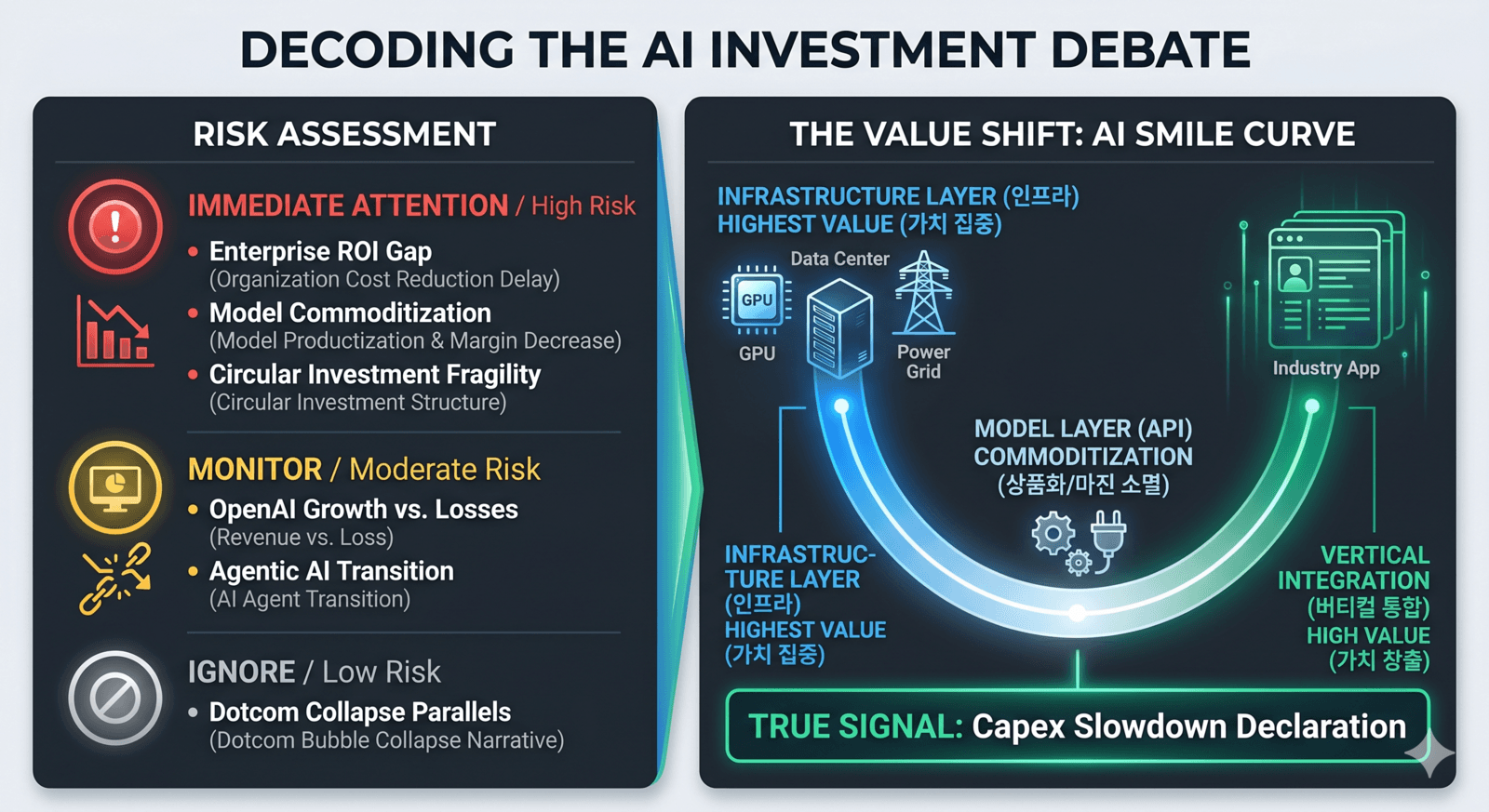
Three risks deserve immediate attention.
First, the enterprise ROI gap. If individual productivity gains don't convert into organizational cost savings, enterprise subscription cancellation pressure arrives first and hits hardest. This is the core vulnerability in the entire AI monetization thesis.
Second, margin erosion from model commoditization. API price compression is already underway. A Jevons Paradox effect — where demand explodes enough to offset the per-unit price decline — is theoretically possible, but until it materializes, the API businesses of OpenAI and Anthropic face structural margin pressure.
Third, circular investment structure fragility. Money is flowing: Nvidia → OpenAI → CoreWeave → Nvidia. With the top five stocks representing 30% of the S&P 500, if any link in that chain breaks, valuation corrections ripple broadly.
Some risks deserve monitoring without overreaction. OpenAI's losses look alarming, but revenue growing 10x in three years is equally real. If agentic AI transition materializes, unit economics change entirely. Microsoft Copilot's market share decline is better read as a monetization model transition than a product strategy failure.
And there's a category you can almost entirely ignore — which, ironically, includes what the media covers most. "This is the dotcom collapse all over again." Hyperscalers are profitable, cash-flow-positive businesses. A collapse to zero revenue is structurally impossible. This is a confusion between two fundamentally different eras.
4. Where Value Is Actually Going — The AI Smile Curve
There's a more practical question than the bubble debate: where does value migrate in this cycle?
The "Smile Curve" concept captures it. In any value chain, value concentrates at the two ends — raw materials and infrastructure at one end, direct consumer touchpoints at the other — while the middle assembly and manufacturing layers see compressed margins.
This is playing out rapidly in AI. The model layer (OpenAI's and Anthropic's APIs) is being commoditized. Meanwhile, value is visibly concentrating in the infrastructure layer (GPUs, data centers, power grids) and in orchestration and vertical workflow layers — AI services deeply integrated into specific industries.
This produces a clear investment selection principle. The faster open-source model commoditization accelerates, the more advantageous it becomes to own infrastructure and vertical integrations that work regardless of which model wins — rather than businesses tied to a specific model.
The actual bubble trigger is worth knowing precisely. It's not a valuation multiple or a stock price movement. It's the moment one hyperscaler declares a capex slowdown. That's the real signal. When it happens, Nvidia, data center REITs, and power infrastructure stocks will experience cascading corrections. Monitor that one sentence, not the noise.
Closing Thoughts
The AI investment debate feels complicated because both sides are partially right. Cloud revenue is genuinely exploding. And the enterprise ROI gap and margin compression are equally real pressures.
So what should we do? After the dotcom collapse, the internet itself survived — and Amazon built AWS through it. The people who came out ahead weren't the ones who predicted whether technology would exist. They were the ones who read, ahead of time, which layer of the value chain would accumulate the gains.
Doing nothing out of fear of a bubble is a valid choice. But it's also a choice to block your own upside. If you believe the direction of technological progress toward AI is correct, scaling in gradually is more realistic than trying to time the peak. You don't need to buy everything at once. You don't need to call the crash. If the direction is right, time works in your favor.
The layer you're in still matters, though. Prioritizing infrastructure and vertical integrations that survive regardless of which model wins — that's the most rational positioning available right now.
Which layer are you standing in?
⚠️ This article reflects personal research and opinion, and does not constitute investment advice for any specific security. All investment decisions and their consequences are the reader's responsibility.