Have you ever wondered?
Why am I not rich? Why does it feel like no matter how much I save, I'm standing still?
I feel like I'm better than yesterday, yet somehow always in the same place.
For office workers dragging themselves to work with nothing but worries (especially me...), this book kicks things off with a fact-based takedown.
The reasons boil down to six main points.
1. It's Not Your Fault You're Not Rich
The book's opening line hits hard: "It is not your fault that you are not rich."
At first I thought it was the usual self-help comfort. But the more I read, the clearer it became — this isn't comfort, it's an indictment.
The authors don't place the blame for wealth inequality on individual effort or talent. The problem, they argue, lies in the monetary system itself — a system monopolized by the state. Those with the power to print money play a structurally rigged game, while everyone else runs the race without knowing the rules.
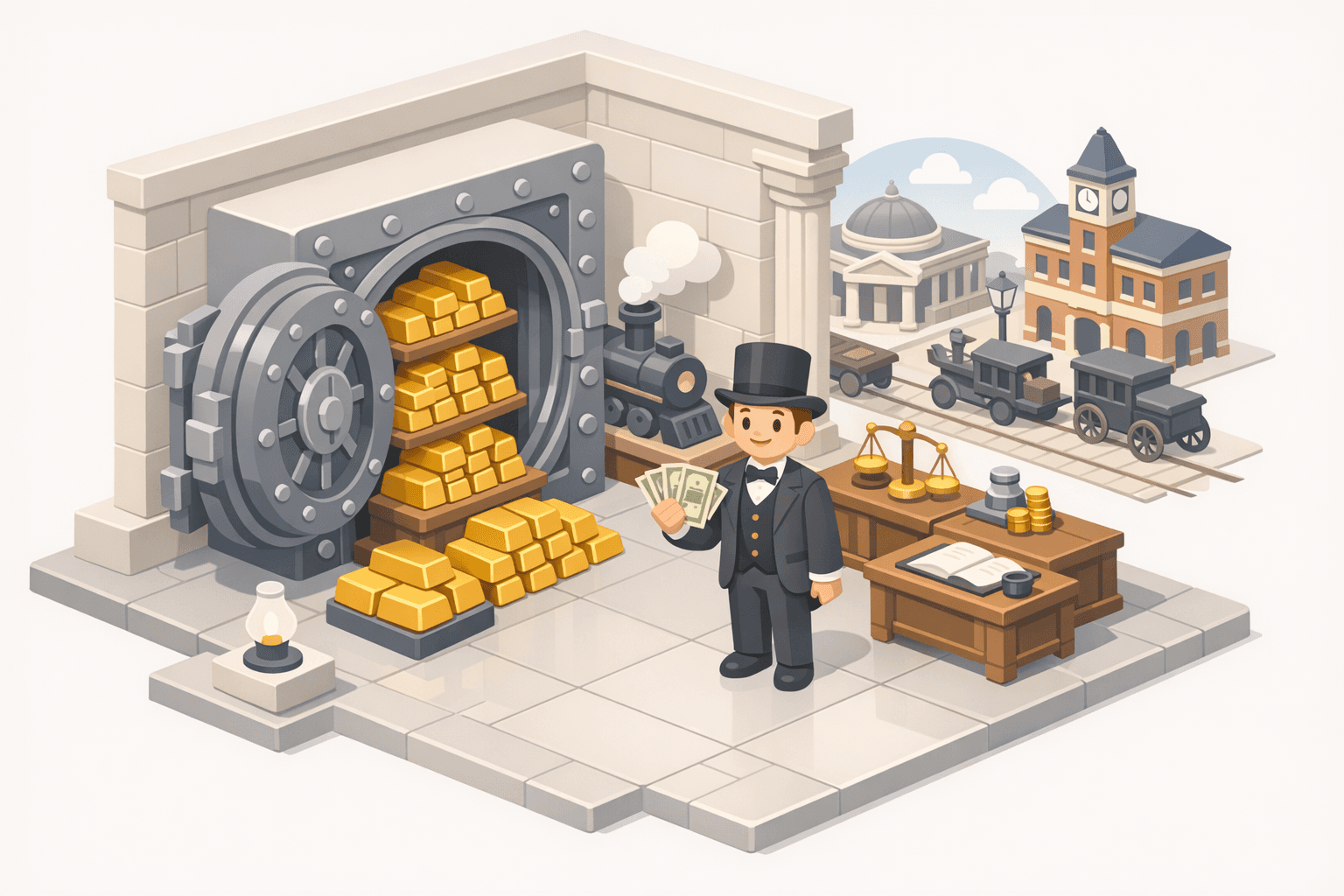
The book opens with a fictional lakeside village. Fishermen, farmers, and gold miners struggle with barter and naturally settle on a common medium of exchange. Gold and silver win out for simple reasons: they're scarce, durable, divisible, and hard to fake. Money was not invented by governments — it was spontaneously invented by markets.
That part is textbook stuff. What comes next is where it gets uncomfortable.
2. Good Money vs. Bad Money
The authors define good money by one criterion: it cannot be arbitrarily expanded by the state. Gold meets this standard. Extracting gold requires enormous labor and cost, which naturally limits supply. Under the gold standard, governments couldn't simply print money at will.
The authors spend considerable time on this era. Under the gold standard, you could buy a house through savings alone within 10–20 years — because money held its value or even appreciated. Today? Save all you want; your purchasing power keeps eroding. The turning point was 1971, when Nixon suspended gold convertibility. From that moment, money was severed from gold and became paper that governments could print virtually without limit.
This is what the authors call "bad money" (fiat currency). It costs almost nothing to produce, its issuance is controlled by a single monopoly, and it can be expanded for political purposes at any time. Gresham's Law — "bad money drives out good" — kicks in here. When bad money floods the market, people hoard good money (gold) and circulate only the bad. That's why we don't use gold in daily life anymore.

3. The Cantillon Effect — First In Wins
Here's the book's central concept: the Cantillon Effect, named after an 18th-century Irish economist.
Newly created money doesn't reach everyone at the same time. There's an order:
- Government and central banks
- Commercial banks
- Large corporations
- Wealthy individuals with collateral
- Ordinary workers — dead last
Those at the top receive new money before prices rise. They use it to buy assets.
By the time an ordinary worker feels the effect — a small raise, news of an improving economy — asset prices have already surged. Your colleague who managed to sign a lease on an apartment may not have been more talented or hardworking than you. They may simply have boarded the train from a different car.
The authors' analogy is sharp: George Soros can borrow a million dollars with a single phone call and buy assets. An average person hesitates in front of those same assets after prices have already climbed. Wealth redistribution flows from the bottom up — the opposite of what most people assume.

There's No Easy Answer. But Hear Out Accusation Two.
The authors' macro-level solution is to end the government's monetary monopoly and allow free currency competition.
Honestly, that's not happening anytime soon.
So the individual-level strategy felt far more practical. The book's direction is simple: hold assets close to real value. Gold has been a proven store of value for millennia. Stocks are grounded in the real value of companies and appreciate in nominal terms as the money supply expands. Real estate, for the same reason, acts as a hedge against currency devaluation.
Paradoxically, in an inflationary system, taking out a fixed-rate loan to buy real assets can be a rational strategy. This isn't a financial tip — it's a conclusion that flows from the logic of the system itself.
But this is just the beginning. Accusation Two may be even grimmer.
See you there.