I invested in SaaS. And honestly — I'm underwater.
Every quarter I watch the earnings releases and tell myself "this is the turnaround." I'm a regular worker-investor. But for the past year, one phrase has taken over my timeline.
"AI is killing SaaS."
It even has a dramatic name: SaaSpocalypse. The moment I heard it, it felt like my portfolio was meeting its end.
I use ChatGPT at lunch, but at work I'm still running Jira, Notion, Slack, and a CRM. Yet one question keeps circling my head.
"Wait — everyone says AI does everything now. So what happens to all these SaaS tools I use?"
And the more practical question: "Is the SaaS company I invested in actually finished?"
This isn't AI optimism or a SaaS defense piece. This is the perspective of someone who works with AI daily and has real money in SaaS stocks — a breakdown of why "AI kills SaaS" is only half-right, and what the structure of survival actually looks like.
My portfolio might be emotional. But this analysis is going to be calm. Let's open up the real story hiding behind the scary word.
Stock Prices Halved, But Revenue Is Rising — The Reality Behind the SaaS Panic
From the second half of 2025, SaaS stocks collapsed collectively. Trillions in market cap evaporated, and a wave of fear swept the market: "AI is replacing the software industry itself."
But the fundamentals told a different story.
ServiceNow's subscription revenue grew over 20%. Datadog's contract bookings surged 37%. Stocks halved; revenue grew. That disconnect says something — the market is pricing in fear far ahead of reality.
That doesn't mean everything's fine. Even excessive fear can be pointing in the right direction. Something structural is shifting, and that signal is real. But "all SaaS is dying" is the wrong diagnosis. The accurate one is more specific.
Which SaaS Dies First — The End of Per-Seat Pricing and Feature-Selling
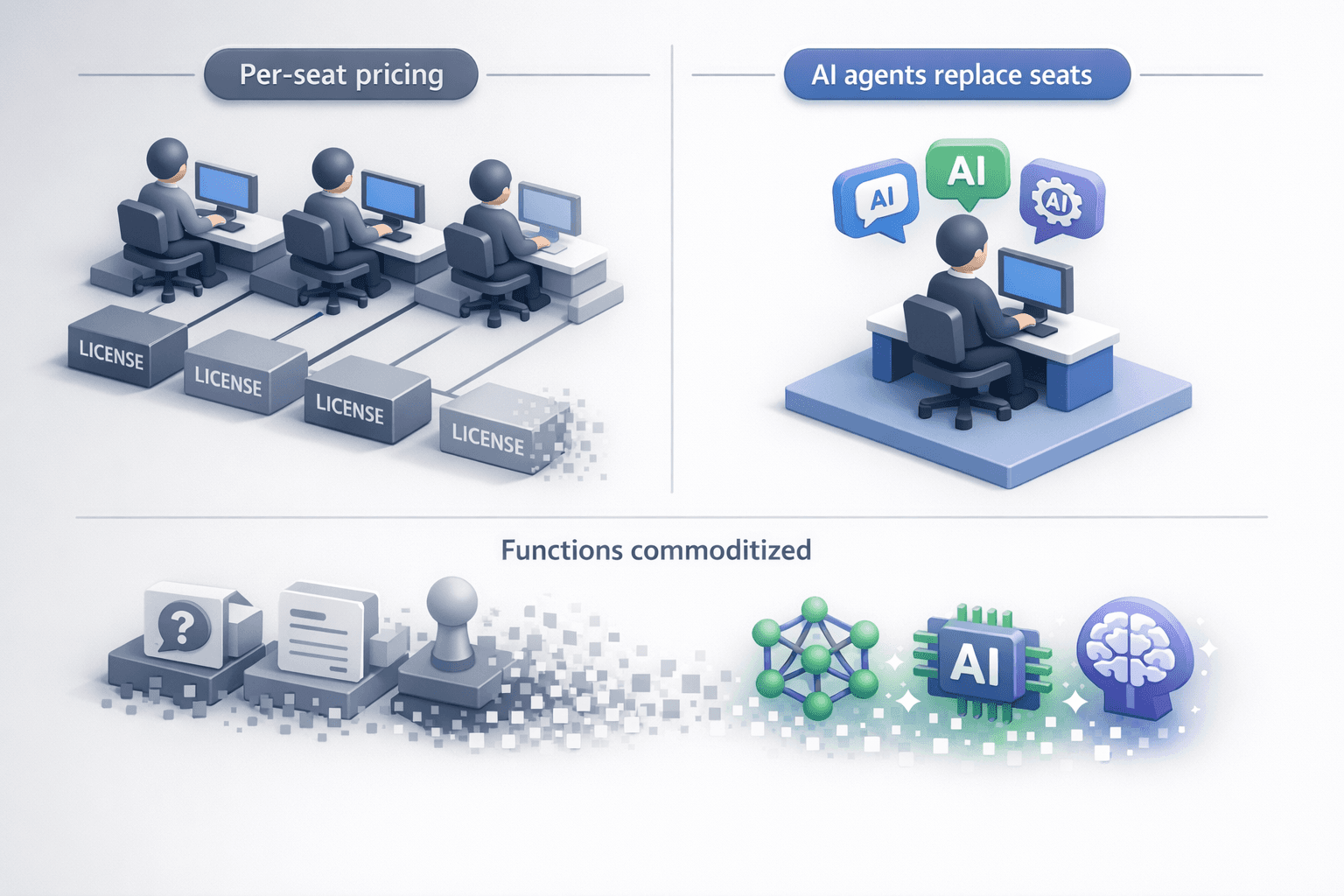
As AI agents proliferate, the number of people who directly operate software inside companies will shrink. One AI-augmented employee can handle five people's workload — which means five licenses are no longer needed. That's the direct blow to per-seat revenue models.
Multiple SaaS company CFOs said the same thing during the Q4 2025 earnings season: customers are now coming to contract renewals asking to cut seat counts. That never happened before.
The first to be displaced: repetitive, rules-based work. First-line customer support triage, invoice processing, attendance approval. SaaS focused on these functions either gets replaced directly by AI, or gets undercut by cheap AI-wrapper startups charging a fraction of the price.
This is commoditization. The old pitch — "our tool has this feature" — was a competitive advantage. Now that AI can generate or replicate that feature, the advantage disappears.
You can feel it in the field. A marketing automation tool the team had been using for years suddenly became "wait, can't ChatGPT basically do this?" Three years ago, that sentence wouldn't have come up at all.
What Surviving SaaS Looks Like — Data Moats and Workflow Lock-In
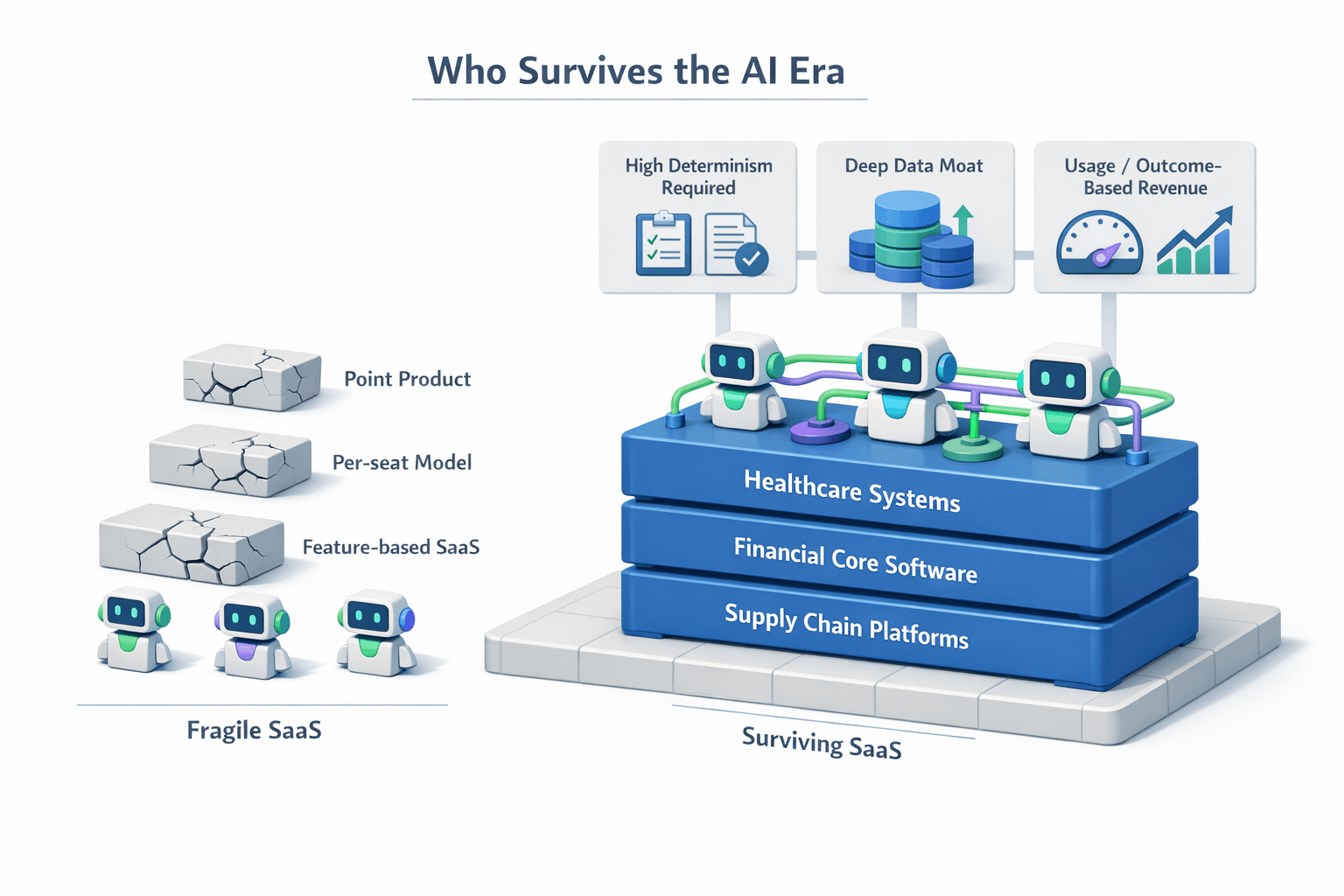
Does everything die? No. The survivors have a different structure.
Electronic health record systems, financial settlement software, supply chain management platforms — these become the foundation that AI has to run on top of. No matter how smart an AI agent is, it has to connect somewhere to execute. That connection point is the SaaS platform where years of data, regulations, and workflows are embedded.
Gartner projects that 35% of point-product SaaS will be replaced by AI agents by 2030. Flip that around: 65% survives. What sits in that 65% is what matters.
Three conditions determine survival:
First, high-determinism requirements. LLMs are accurate roughly six times out of ten. Medical diagnosis, financial underwriting, regulatory reporting require 100% consistency. Current technology makes it practically impossible for AI to replace the core systems in these domains — CIOs on the ground say so.
Second, a deep data moat. The more customer data accumulates on a platform, the more AI has to run on top of that platform too. SaaS that isn't just selling features but holding data as an asset is a different category entirely.
Third, speed of revenue model transition. Companies shifting from per-seat to usage-based or outcome-based pricing can maintain ARPU even as user counts shrink. Fail to make that shift and the same product structurally bleeds revenue.
Is Vertical SaaS a Victim or a Winner?
There's one more interesting angle.
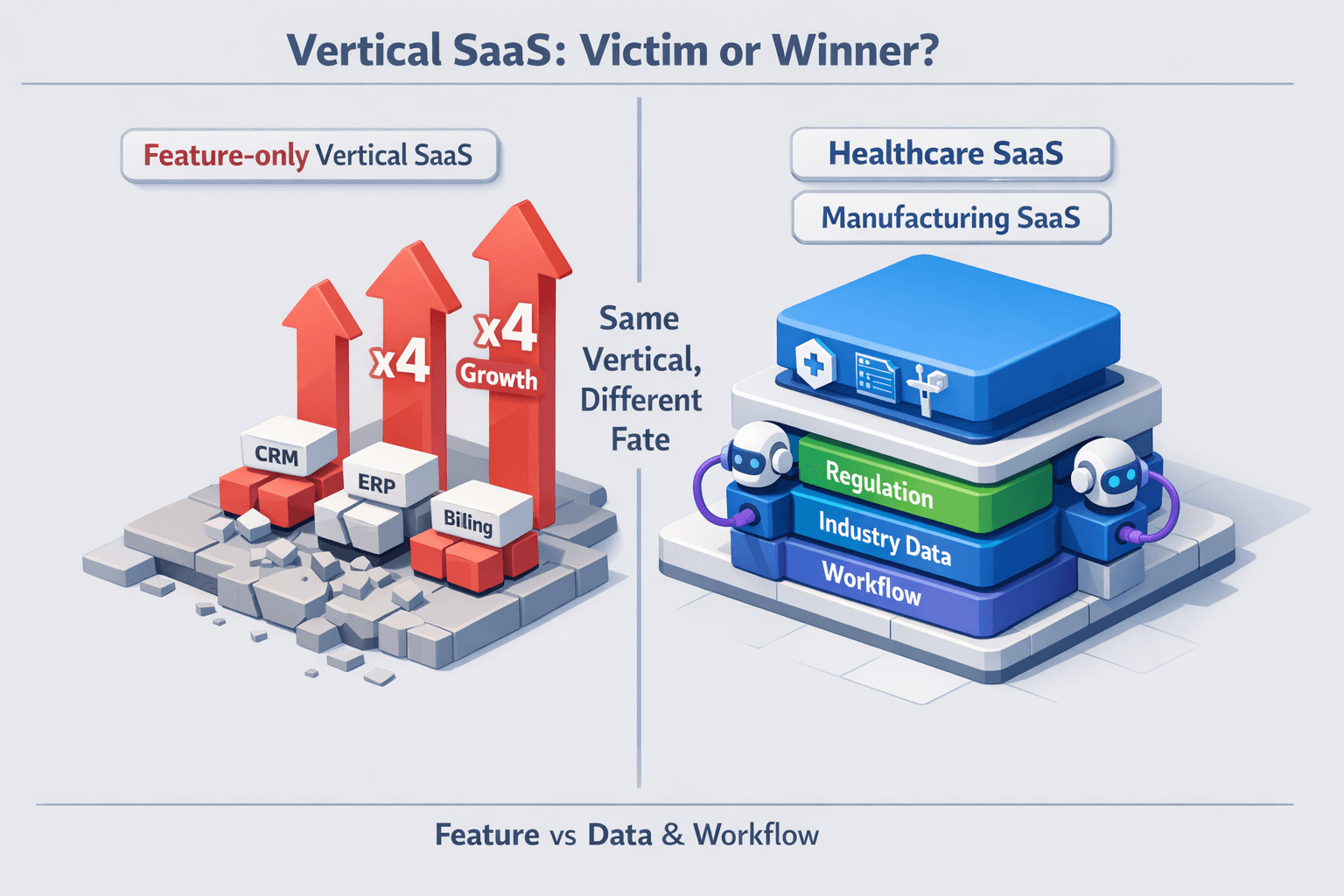
Specialized vertical markets — healthcare SaaS, manufacturing SaaS — are actually growing. Forrester data projects expansion from $133B to $194B. Meanwhile, some VC analyses show AI-native vertical startups growing 400%+ and threatening established vertical SaaS players.
Both are right. It's just a matter of segmentation.
Vertical SaaS that has spent years handling a specific industry's regulations, data, and workflows is hard for AI to replicate. But within a vertical, simpler feature-only products are absolutely getting eaten by AI startups.
The same logic repeats: is it a feature, or is it data and workflow?
So What Should We Actually Do?
The right action depends on which seat you're sitting in.
If you work at or in the SaaS industry:
Start by asking whether the product you're part of is selling features or selling data. Feature-driven products face fast replication and replacement — and if the company doesn't shift its revenue model, structural pressure arrives within three to five years. If you're in a domain where deep customer data accumulates and regulations are complex, AI is more likely to become a partner than a replacement.
For career decisions — learn to tell whether your role sits on top of replaceable workflows or on top of infrastructure that AI has to connect to.
If you hold SaaS stocks or tech assets:
Right now the market is pricing AI fear so severely that strong SaaS and weak SaaS are falling together indiscriminately. The moment that distinction starts showing up in stock prices is when the real sorting begins.
Three screening criteria, kept simple:
One — has the company started shifting from per-seat to usage- or outcome-based revenue?
Two — does the platform accumulate customer data structurally, or is it purely selling features?
Three — what do the actual quarterly revenue numbers look like? Check the earnings reports to see whether the stock decline reflects an earnings decline, or just fear.
"Avoid all SaaS" is wrong. "SaaS is fine" is also wrong. Which SaaS is everything.