Open any Ethereum news feed these days and you'll see opposite headlines side by side. "Institutional money is pouring in — ETH breakout imminent" sits right next to "Ethereum's structural flaws point to $1,700." At first it seems like one of them must be wrong. But both have real backing. That's exactly what makes ETH so hard to read right now. Here's my full breakdown.
Is L2 Growing Ethereum or Eating Into It?
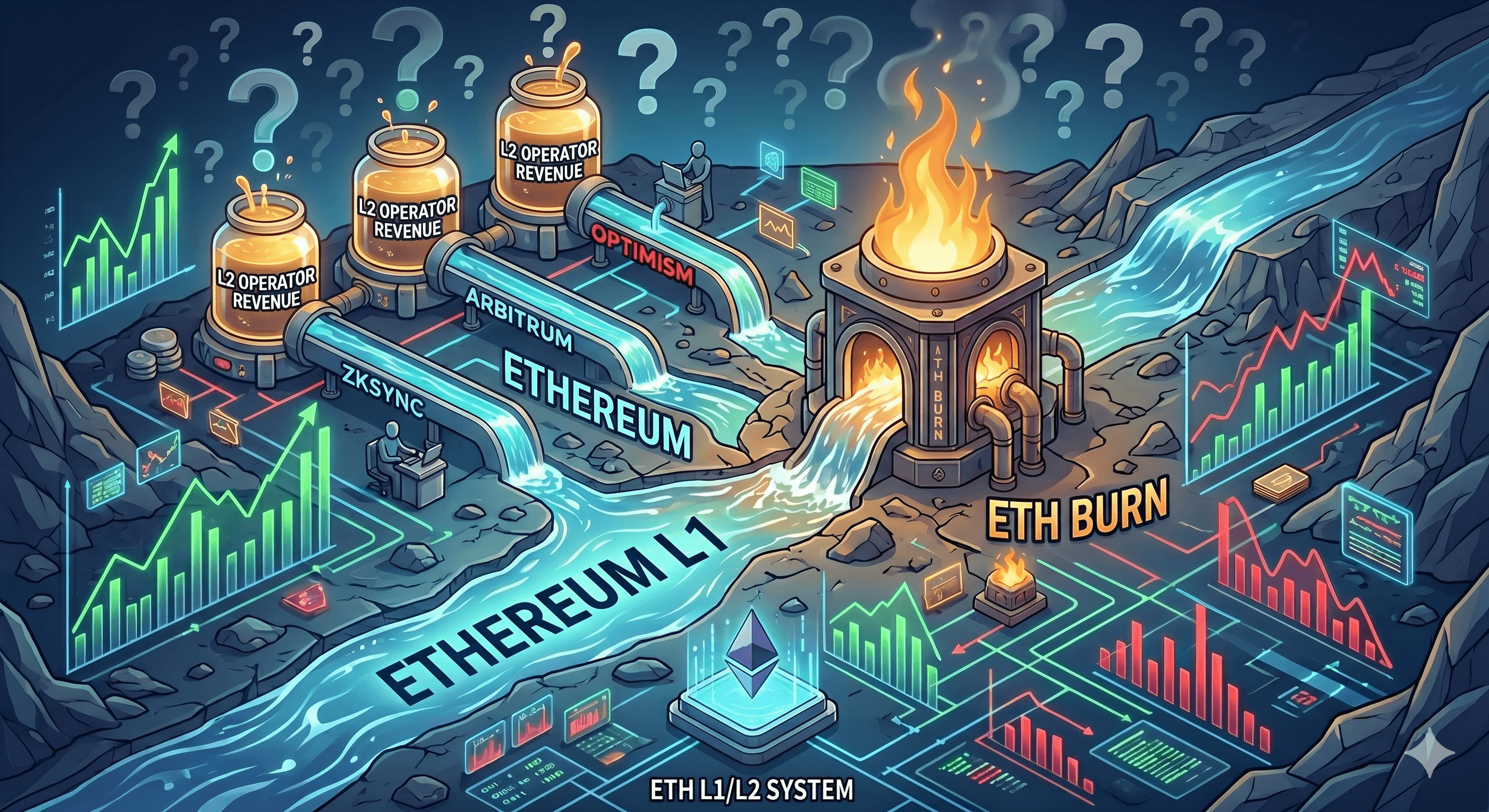
Layer 2 (L2) was designed to solve Ethereum's congestion problem. Transactions are processed on L2 and only the final results are recorded on L1 — faster and cheaper for users, which sounds like a win.
For investors, though, the picture is more complicated. Under the old model, higher network usage meant higher gas fees on Ethereum, a portion of which was burned, shrinking the ETH supply. Less supply meant upward price pressure. As L2s have proliferated, that link has weakened. One estimate suggests that Base (Coinbase's L2) alone has been responsible for roughly $50 billion in lost ETH market cap — because fees flow to L2 operators instead of being burned on L1.
ETH's 30-day fee revenue currently sits around $10.3 million — lower than Tron and Solana. Usage is growing while revenue is actually falling. That's the paradox.
L2 expansion is genuinely growing the Ethereum ecosystem. But the path from that growth back to ETH token price has become much narrower than it used to be.
Institutions Are Coming In — So Why Is the Price Like This?
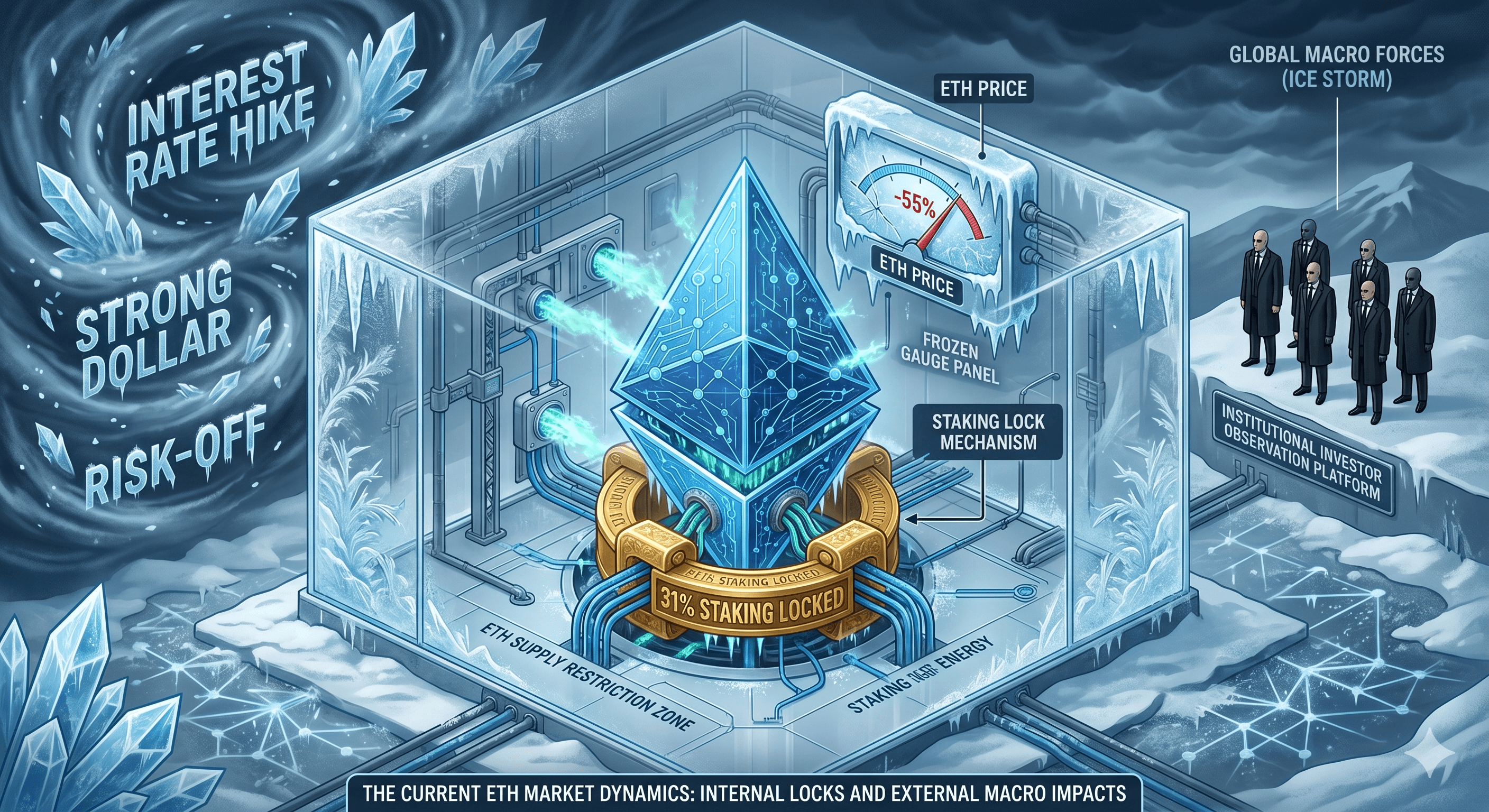
BlackRock launched ETHB. Grayscale and Bitmine staked $500 million worth of ETH within 48 hours. Staking ETF AUM crossed 40%. These sound like strong bullish signals.
Yet ETH is down 55% from its all-time high.
There's a reason. ETF inflows don't automatically translate into price appreciation. In October 2025, $1 billion flowed out in a single week. Institutional capital is highly sensitive to macro conditions. When interest rates rise, the dollar strengthens, or risk-off sentiment takes hold, institutions sell ETH and exit. Staking lock-ups reduce circulating supply, but a large-scale outflow can neutralize that effect within days.
The staking lock ratio is now at an all-time high of approximately 31% of total supply (37.25 million ETH). That number genuinely matters — supply compression is becoming a real mechanism supporting the price floor.
But the critical distinction is whether institutional money is flowing in because they believe in Ethereum, or as part of portfolio diversification. The former implies long-term holding; the latter means they'll exit when macro deteriorates. Right now, the latter seems to dominate.
Is Solana Beating Ethereum? — DeFi Market Share Comparison
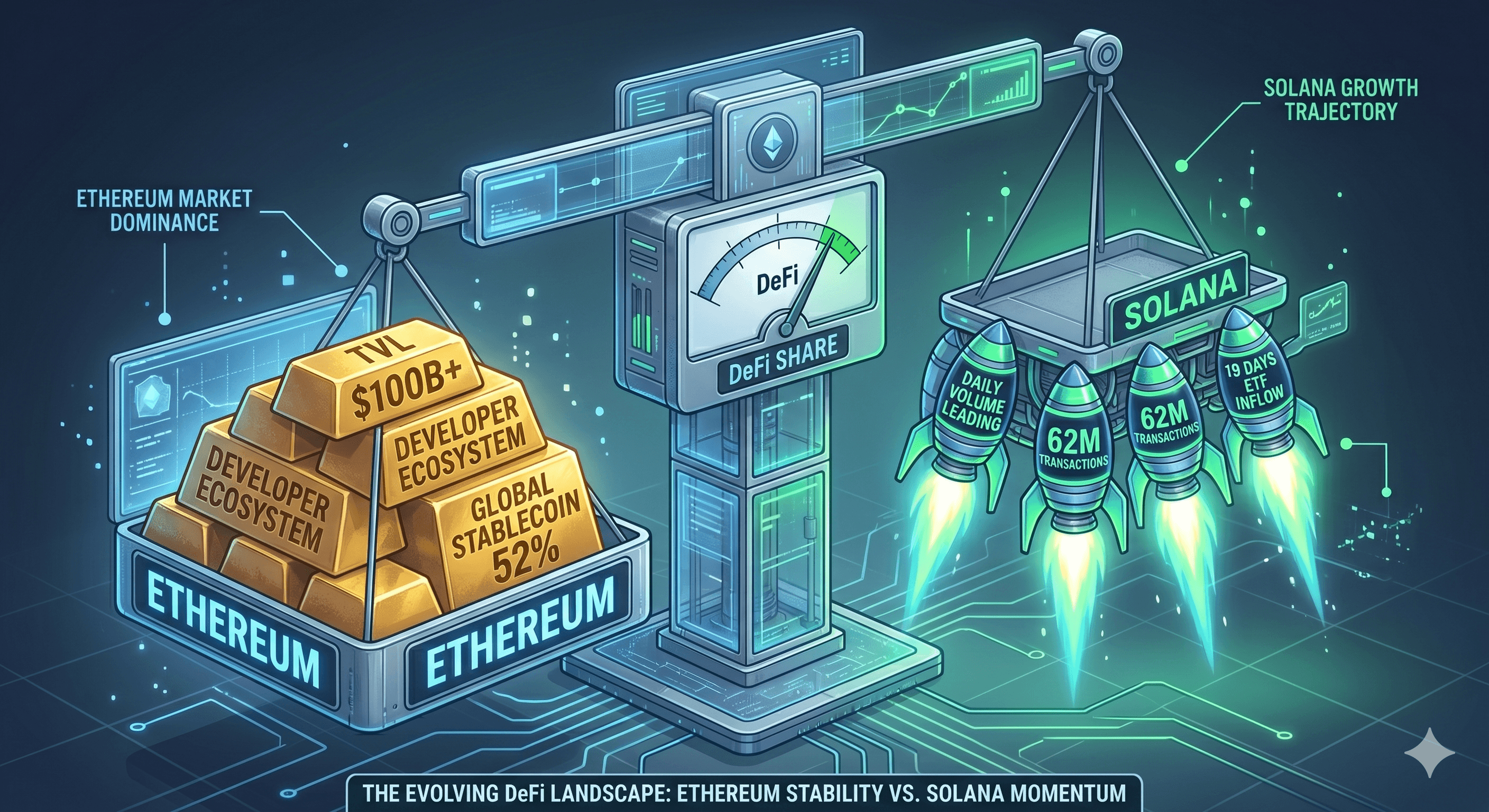
Ethereum's TVL (Total Value Locked in DeFi) exceeds $100 billion. Solana's is $8.7 billion. In absolute terms, it's not close.
But daily transaction counts tell a different story: Solana at 62 million versus Ethereum's 1.2 million — a 50× gap. By transaction volume, Solana has already pulled ahead.
Institutional capital has also been flowing into Solana ETFs for 19 consecutive days ($476 million). Retail and institutional money alike are moving toward Solana.
To be clear, Ethereum still dominates in major DeFi protocols, stablecoin issuance (52% of global supply), and developer ecosystem depth. For Solana's DeFi to absorb institutional capital, it will need years of smart contract re-audits and regulatory groundwork.
But "Ethereum is #1 in DeFi, so it's safe" is no longer a sufficient thesis on its own. Solana has started capturing retail user experience on speed and cost, and that momentum could translate into TVL migration over the long term.
The Upgrade Is Positive News — So Why Is the Burn Declining? — The Fusaka PeerDAS Dilemma

The Fusaka upgrade (including PeerDAS) has already been deployed. Its purpose is to drastically reduce the cost of L2s posting data to Ethereum — specifically blob fees. Lower costs for L2s mean lower fees for users, which sounds straightforwardly good.
But here's the paradox: lower L2 data costs → less ETH burned on L1 → weaker supply compression.
The network is getting technically better, but ETH's value capture is being diluted. The upgrade has a dual nature: a short-term headwind for ETH price, but a long-term tailwind for the ecosystem.
Solving this requires an EIP-level mechanism change that routes a portion of L2 fees back to L1 burning. That conversation is ongoing, but a timeline for implementation remains uncertain.
So What Should We Actually Do?
Approaching ETH right now as "it's down 55%, time to buy the dip" is dangerous. There's no guarantee this is the bottom, and without structural issues being resolved, any technical bounce can reverse just as fast.
That said, there's no reason to completely sit on the sidelines either.
If you're going to position in ETH, the framework should come down to two checkpoints.
First: the macro environment. ETH is still a risk asset. In a strong-dollar, prolonged rate-hold environment, institutions sell ETH. Conversely, when rate-cut expectations build and risk-on sentiment returns, institutional ETF inflows come back. Going into ETH purely on technicals without macro clarity is a good way to get the timing badly wrong.
Second: weekly staking lock changes and ETF flow direction. These are the real mechanisms protecting ETH's price floor in this cycle. They're far more direct signals than headlines about rising on-chain active addresses. If staking locks are increasing and ETF inflows are sustained week-over-week, dollar-cost averaging becomes a reasonable approach. If ETF outflows run consecutive weeks, staying on the sidelines is the right call.
On sizing: ETH belongs in a portfolio as one position among many. A concentrated single-asset bet on ETH doesn't fit the current structure. The right moment to add meaningfully is when the L2 value leakage problem gets fixed — specifically when an EIP mechanism actually routes L2 fees back to L1 burning. Until then, acknowledge the ecosystem's foundation, but confirm structural change before chasing price momentum.
ETH has shifted from a "buy and believe" asset to a "buy on conditions" asset. Checking whether those conditions are being met on a weekly basis is the most realistic approach available right now.
Disclaimer: This post is not investment advice. All investment decisions and their consequences are the sole responsibility of the investor.