Watching Dune — This Wasn't Science Fiction. It Was a Systems Analysis.
I was reading an AI industry report at work when it hit me.
Wait. I've seen this structure before. In Dune.
Frank Herbert wrote Dune in 1965. And yet, more than half a century later, the architecture of that novel maps onto our present with unsettling precision.
Not as allegory. As a record of patterns humanity keeps repeating.
I couldn't shake the thought, so I wrote it down.
The Spice Hegemony — From Oil to Semiconductors and AI
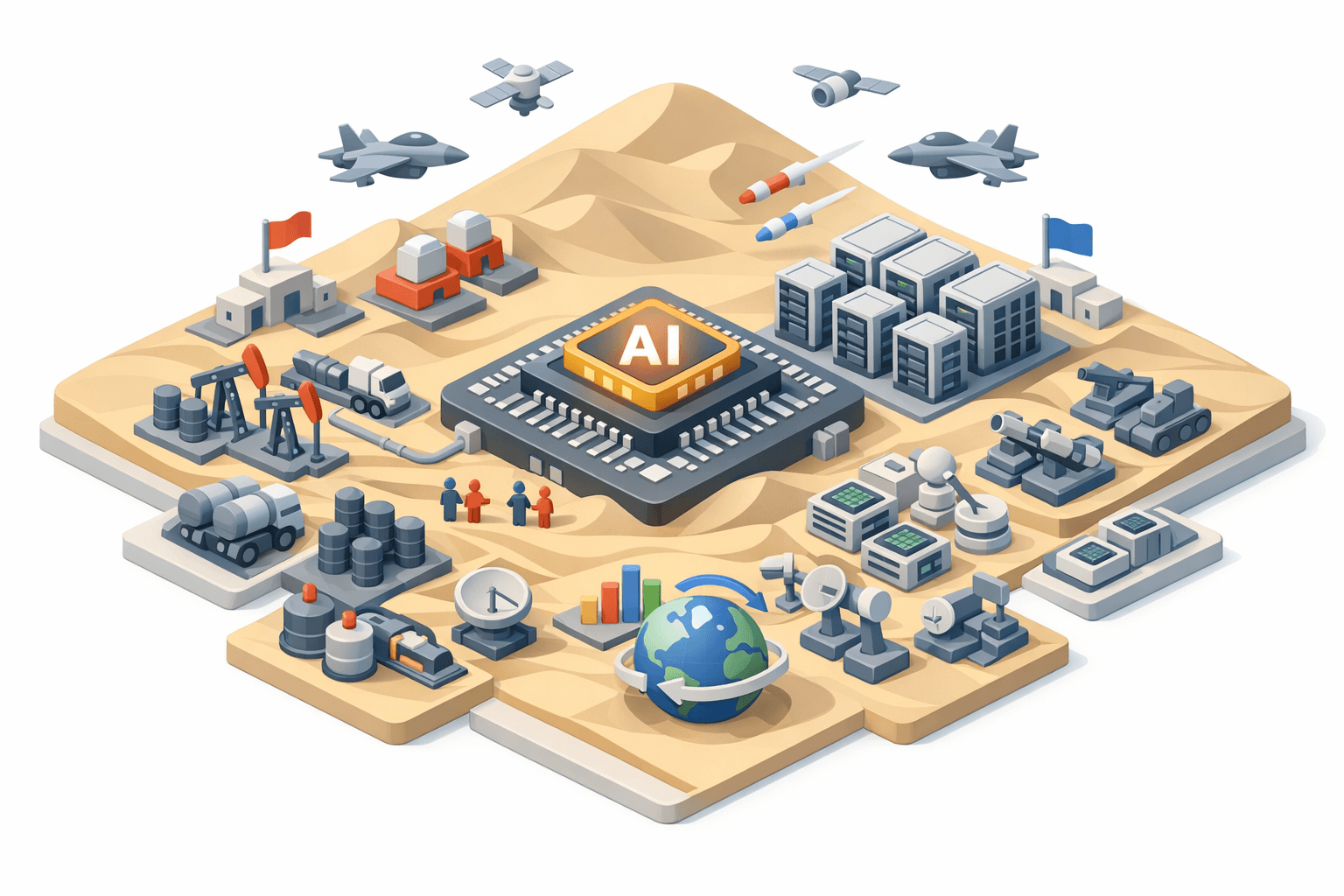
In Dune, spice wasn't just a resource. Without it, interstellar travel stopped. Economies collapsed. Military power evaporated. It was the operating condition of civilization itself.
Herbert intended a clear allegory: Arrakis is the Middle East; spice is oil.
But from today's vantage point, the next spice candidates are already taking shape. Rare earth elements, lithium, and AI compute infrastructure. Without batteries and semiconductors, the modern economy literally halts. AI is going further — rapidly becoming the layer on which entire military, financial, and social systems depend.
"He who controls the spice controls the universe" now sounds like this: he who controls the semiconductor supply chain and AI infrastructure controls the 21st century. This is precisely why the US and China are fighting a semiconductor war.
The Butlerian Jihad Revisited — AI Treaty or Cognitive Class Society?
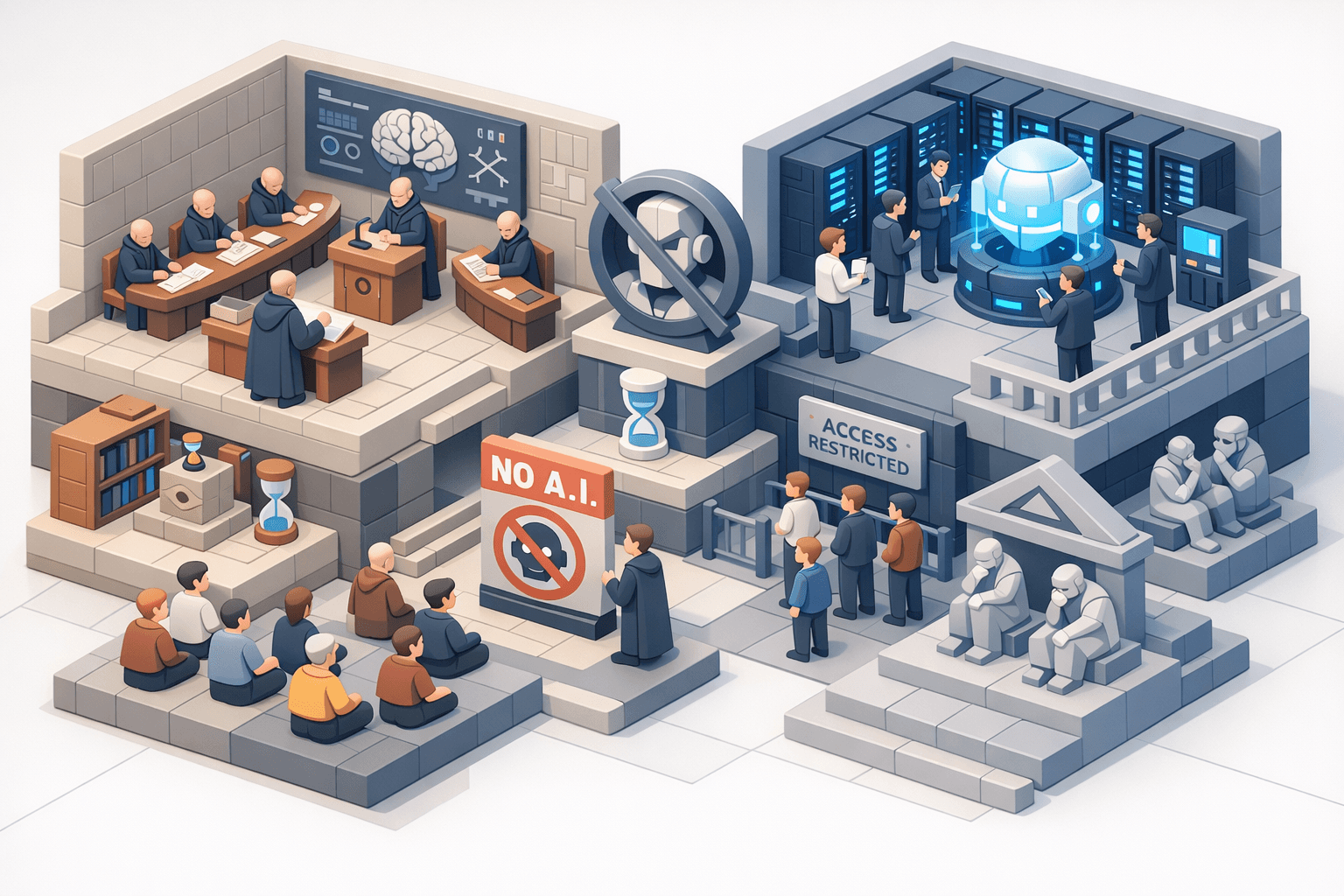
The most pivotal event in the Dune universe was a war that outlawed "thinking machines" entirely. On Earth, this scenario seems to be splitting into two paths.
One is the prohibition scenario. If AI escapes control or causes mass harm, international treaties ban development beyond a certain threshold. The vacuum gets filled by elite human specialists — analysts trained in pure logic, experts conditioned to memorize and process vast information. This is precisely the Mentats of Dune.
The other is the symbiosis scenario. Instead of a ban, institutions are built to keep AI as a tool only. But the problem remains: the cognitive gap between those who can freely use AI and those who can't becomes a new class structure. Either way, a cultural taboo — "do not delegate judgment to machines" — will likely emerge.
The Bene Gesserit and the Global Elite — The Invisible Long-Game

The essence of the Bene Gesserit is a knowledge-and-information elite executing plans that span centuries. It's hard to argue this has no equivalent on Earth today.
A handful of tech companies control the flow of information for the entire world. Institutions like the IMF and BIS design long-term economic policy without democratic mandate. Just as the Bene Gesserit planted specific worldviews in advance through their Missionaria Protectiva, the architectural design of discourse through media and education is already operating structurally.
There is one difference. The Bene Gesserit at least had a purpose: to save humanity. The Earth version's intentions are often far less clear. That may be the more dangerous part.
Arrakis's Ecological Crisis — The Same Structure as Climate Change
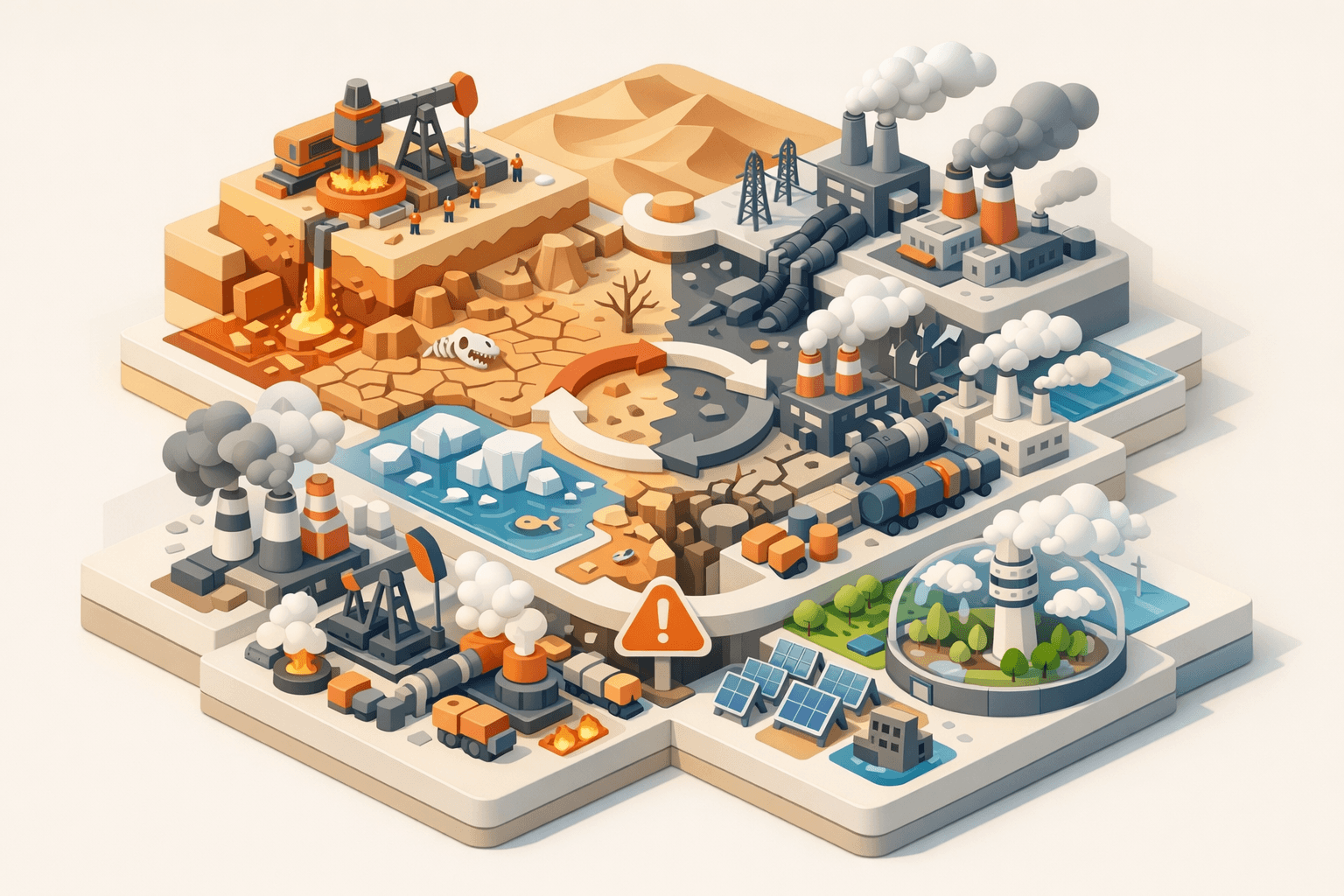
In Dune, Arrakis's ecosystem was a shared resource that every power exploited and no one took responsibility for. To mine spice, you had to disturb the sandworms. Without sandworms, there was no spice. A perfect structure of self-destruction.
Climate change is exactly the same. Burning fossil fuels keeps the economy running, but the more you burn, the more you destroy the ecosystem that sustains the economy. What Herbert warned against wasn't simple environmental destruction. It was the inevitable failure of trying to change planets without changing the logic of extraction.
The detail that terraforming Arrakis ultimately threatened the sandworms — and thus the spice itself — overlapping with today's debates about carbon capture and geoengineering is probably not a coincidence.
Paul's Dilemma and Social Media — The Messianic Impulse Puts Civilization at Risk

Herbert's sharpest warning was against humanity's habit of delegating judgment to a superhero. Paul started with good intentions — but his emergence triggered a jihad that killed billions. No one could stop it.
History repeating this pattern needs no elaboration. The problem is that today it moves faster.
Social media algorithms amplify charismatic figures at unprecedented speed. Crowds delegate their judgment. The power that receives that delegation invariably produces outcomes that diverge from the original intent. This is a structural problem that crosses left and right ideologies alike.
Herbert's proposition — that the very desire for a messiah puts civilization at risk — lands much heavier now, in an era when algorithms manufacture messiahs at industrial scale.
Dune, Earth, and the Golden Path
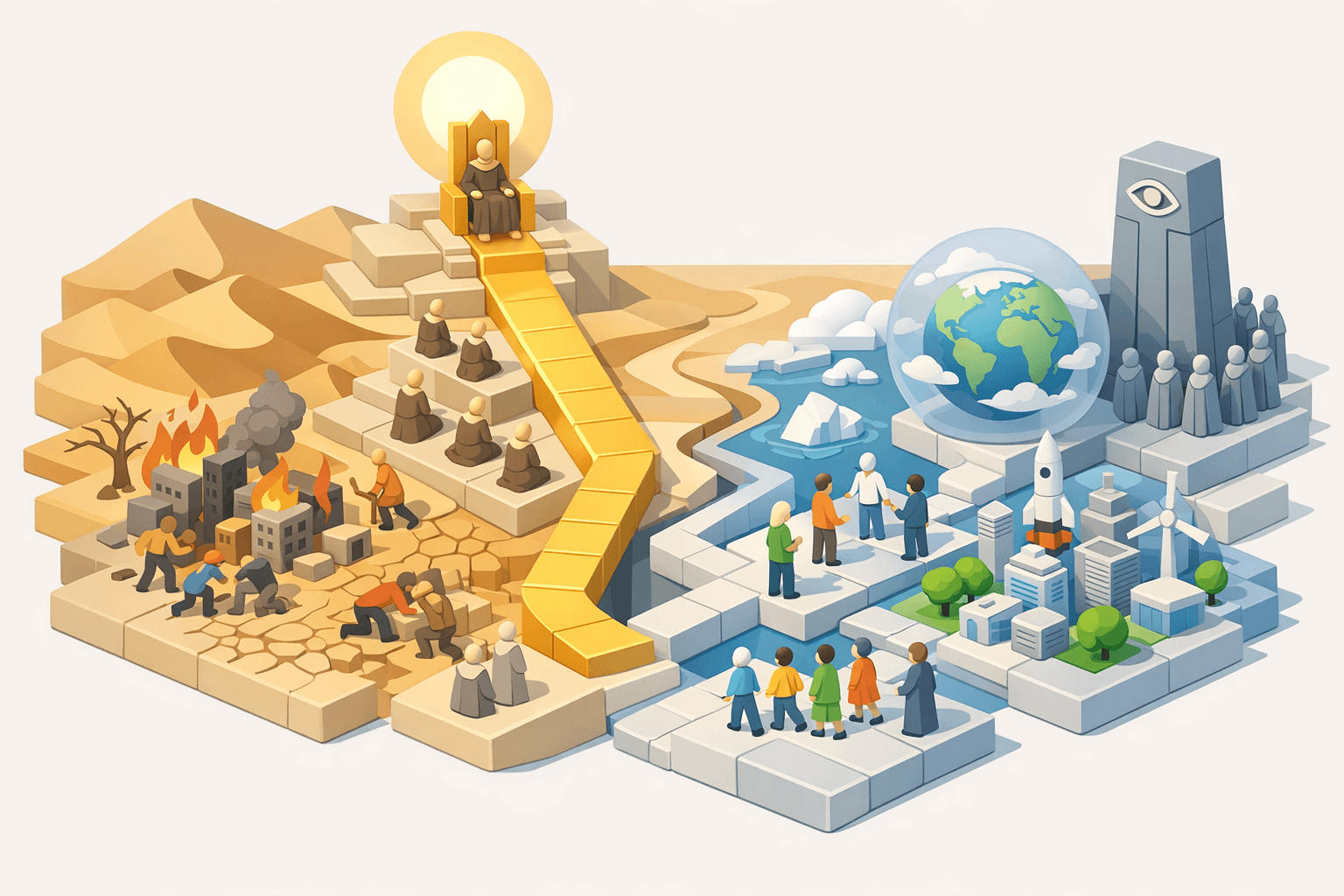
Leto II's Golden Path, which runs through the entire Dune saga, was a cruel paradox. By forcing humanity to directly experience the agony of complete subjugation to a single prescient vision, he awakened the innate drive to disperse and diversify. His cold diagnosis: without that suffering, nothing would change.
The climate crisis, AI anxiety, political polarization, and resource conflict that humanity is experiencing now may share the same structure as the pain of the Golden Path. Only after sufficient suffering does humanity abandon dependence on a single savior or a single system, and choose decentralization and diversity instead.
Herbert believed humanity repeats the same mistakes — only at greater and greater scale. But he also noted that surviving through those repetitions is equally human. Mapping the Dune universe onto reality keeps bringing me back to the same question: can we make the choice ourselves before we suffer through the Golden Path? Herbert was pessimistic. But the act of continuing to ask the question may already be the beginning.
So What Do We Actually Do?
Two things.
Don't delegate your judgment. And figure out what the next spice is — yourself.
On the first: the Fremen survived in Dune not because they trusted Paul. They survived because they already knew how to read the desert themselves. The moment we hand our judgment over to AI, to algorithms, to YouTube experts, we stop being Fremen and become Harkonnen infantry — waiting for orders and dying in the sand.
This isn't an argument against using AI. Use it as a tool. But maintain the structure where you draw the conclusions. That distinction is also the difference between a Mentat and a computer.
On the second: the investment lens. Applying Dune's lesson at the macro level is simple. Get onto the side that holds the next spice — but don't go all-in on a single resource.
Right now, there are three next-spice candidates: semiconductor design and manufacturing infrastructure; the data centers and power grids that run AI compute; and the lithium and rare earths at the core of batteries and EVs. These three axes, like Arrakis, have no substitute or an extremely limited one. The structure of civilizational dependency is already in place.
But as Herbert warned, the side that becomes too dependent on spice ultimately becomes vulnerable. The same goes for a portfolio. Concentrate in one sector and you become the Emperor — helpless without Arrakis. Diversification is the Golden Path.
Dune's final message applies to individuals too. Know what the spice is. Get on its side. But don't become its servant. That's how the Fremen survived — and it's still a valid strategy for us today.

— After watching Dune: Part Two —