Payday has been less exciting for a while now, but lately I catch myself pausing in front of gas stations. Brent crude has blown past $100 — up from the $60s before the conflict started. It looks like a simple energy price story, but it's actually connected to interest rates, inflation, and the stock market. With so much noise out there, I wanted to put it all in order.
Why Oil Is Actually Rising: The Hormuz Blockage
The first thing to understand is the supply structure. The current price spike isn't driven by rising demand — it's a supply shock.
The Strait of Hormuz is the critical chokepoint for crude oil transport, with over 130 vessels passing through daily. Right now, that passage is effectively blocked. The shutdown of 13 million barrels per day in supply sent markets into a panic, and Brent crude jumped more than $40 in a short period.
The structural vulnerability for South Korea is stark. More than 95% of Korea's crude oil imports pass through this strait. Every $20 rise in oil prices adds roughly ₩10 trillion in annual import costs. Prices have risen more than twice that — meaning over ₩20 trillion in additional costs is already materializing.
Why "Prices Normalize When the War Ends" Is Wrong
Many people expect oil to snap back to $60 the moment a ceasefire is announced. That's a dangerous miscalculation.
Société Générale analyzed major oil supply shocks over the past 70 years. Full normalization took an average of eight months. The same was true during the Suez Canal closure and the Iraq War. The equation "deal = immediate normalization" runs directly against the historical record.
The reason is simple: logistics infrastructure takes time to restore, ships need to be repositioned, storage and inventory levels take time to reset. Even after supply starts flowing again, markets take additional time to "believe" it. Full normalization, optimistically, arrives in late 2026. That's the realistic timeline.
For investors, this is an important point. Energy sector tailwinds persist for a while even after a conflict ends.
Two Opposing Forces Are Running Simultaneously
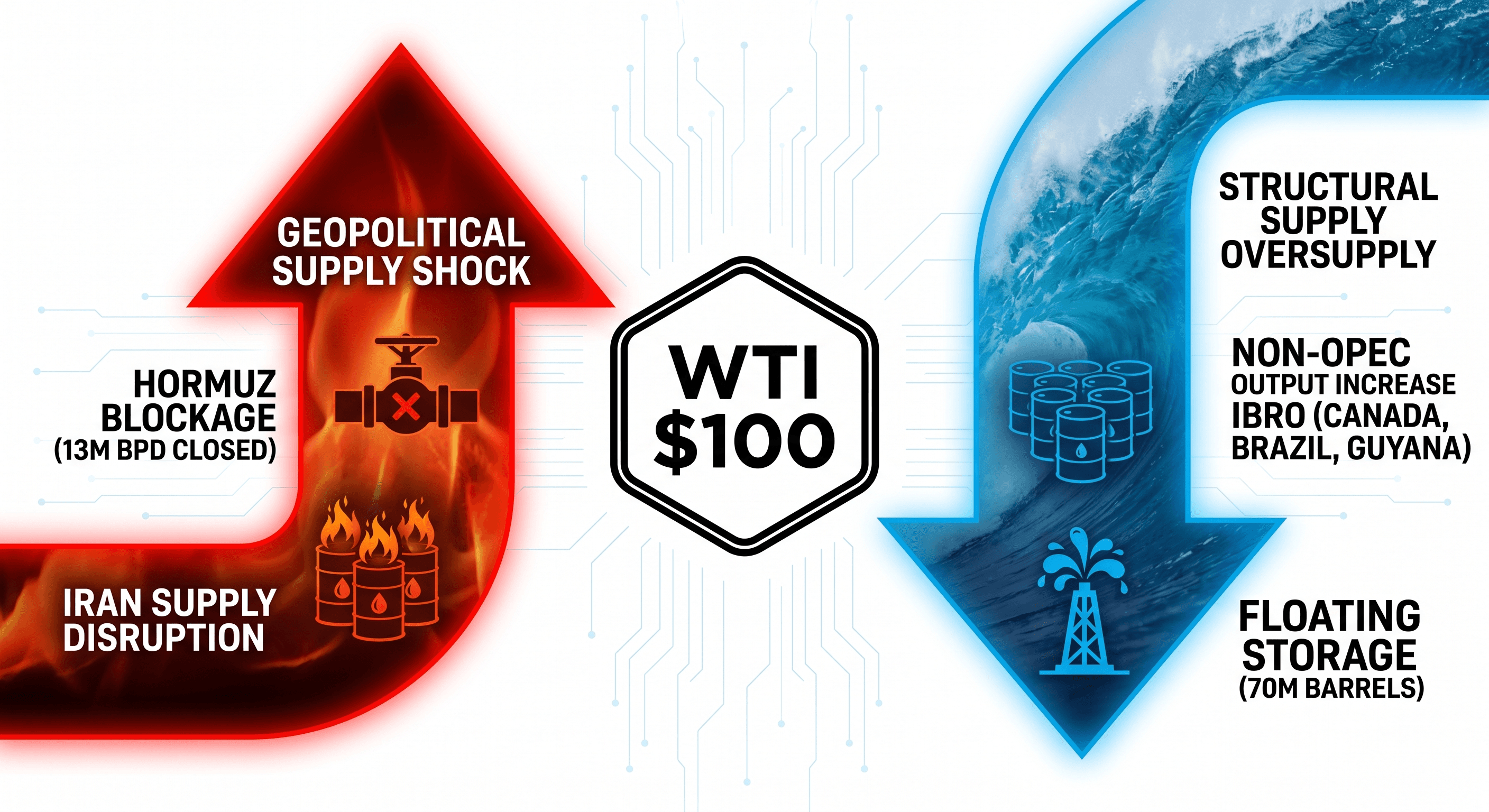
Understanding today's oil market accurately means holding two opposing forces in mind at the same time.
On one side: geopolitical supply shock. The Hormuz blockage has cut off 13 million barrels per day, and Iranian crude supply — 1.5 to 1.7 million barrels — faces additional disruption. This force is currently dominating the market.
On the other side: structural oversupply. Non-OPEC producers like Canada, Brazil, and Guyana have added over 1 million barrels per day in new output, and floating storage holds 70 million barrels. Goldman Sachs and the EIA were both forecasting medium-term price declines before the blockage began.
Right now, the supply shock is overwhelming the structural oversupply. But the moment the blockage lifts, that suppressed oversupply comes to the surface. Whether prices then crash or decline gradually depends on OPEC+'s willingness to cut. Historically, OPEC has never allowed prices to fall below $60 without intervention.
The Real Risk Isn't Oil Itself: The Inflation → Interest Rate Chain
The most important thing to watch isn't simply the cost of gasoline.
If oil stays above $100 for more than two months, US PCE inflation could come in 0.2–0.4 percentage points higher than expected. That delays interest rate cut expectations. When rate cut expectations retreat, the dollar strengthens, and growth stocks and long-duration bonds take the first hit.
This is the mechanism by which an oil story stops being an energy sector story and becomes an entire asset market story. If the blockage exceeds two months, this chain becomes likely. That is the core risk at this moment.
Conversely, oil staying above $120 for an extended period is unlikely. At that level, global demand itself begins to fall — a self-correcting feedback that naturally caps prices.
Conclusion
So should you buy oil-related assets right now?
The honest answer: position review comes before new entry. Brent at $103 already prices in a significant portion of the supply shock. Buying more here is a bet that "the blockage lasts longer" — which is a geopolitical timing game. Most people don't win those.
If you already hold energy sector positions, there's no reason to sell in a panic either. Even after a deal, oil comes down slowly. History says eight months. Energy company earnings hold up through that period.
What deserves more attention is the other side of your portfolio. Positions built on rate-cut assumptions — growth stocks, long-term bonds — are vulnerable. If oil holds above $100 for two months, inflation numbers move higher and rate-cut expectations get pushed back. That is the chain to watch most carefully.
The right question right now isn't "what should I buy?" It's "can my portfolio survive delayed rate cuts?" Oil will eventually come down. But when it comes down shapes the path of your assets considerably.
Investment Disclaimer: This article is for informational purposes only and does not constitute investment advice or a recommendation to buy or sell any specific asset. All investment decisions and their consequences are the responsibility of the individual investor.