Every time I go to the grocery store lately, something feels off. The cart looks roughly the same as last year, but the number at the checkout is different. Interest rates are up, loan payments have grown, and yet the paycheck hasn't kept pace. Is this just a bad economic cycle, or has something structural shifted? That question led me to this book.
The Great Demographic Reversal by Charles Goodhart and Manoj Pradhan. The short answer: what we're experiencing may not be temporary.
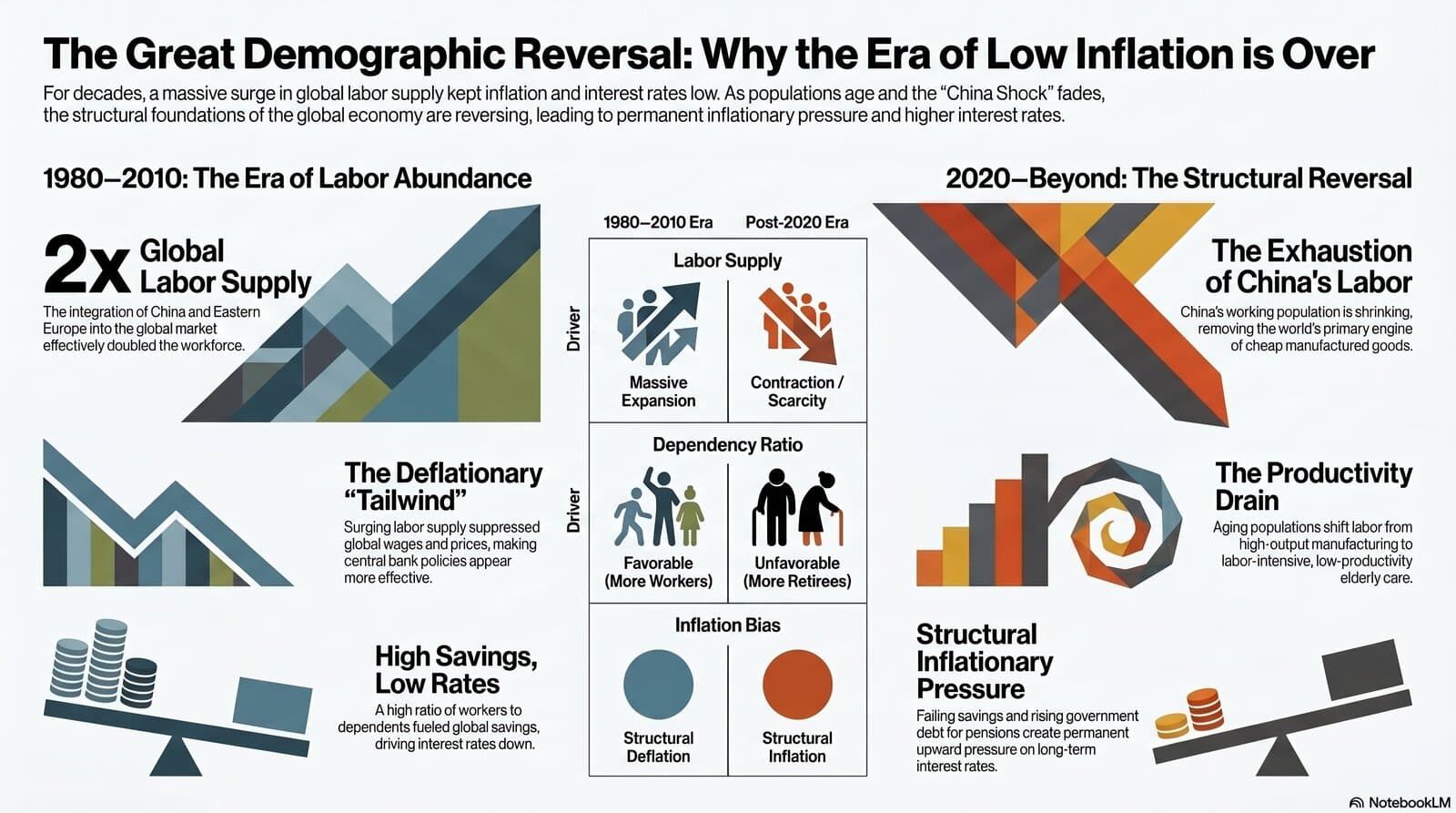
Why Inflation Was Low for 40 Years — A History of Labor Supply Explosion
The book opens with a deceptively simple question: why were global prices so stable from the 1980s through the 2010s?
Textbooks credit central banks. The Fed managed rates well; inflation targeting worked. Goodhart pushes back hard. Central banks weren't especially skilled — they were riding a massive tailwind. They got credit for a climate they didn't create.
That tailwind was an explosive surge in global labor supply. Five forces converged between the 1970s and 2010 to effectively double the world's workforce:
Post-war Baby Boomers reached working age. Women entered the labor market en masse. Falling birth rates reduced the ratio of dependents to workers. China joined the WTO, adding hundreds of millions of low-wage workers to global supply chains. And Eastern Europe integrated into market economies after the Soviet collapse.
When supply doubles, wages stagnate and prices stay low. Central banks were sitting atop that current, not steering it. As Goodhart puts it, policymakers claimed credit for an environment that demographics built for them.
The China Variable — And Its Disappearance
Goodhart doesn't treat China as a footnote. It's the book's dominant theme.
China's integration into the global economy was an unprecedented supply shock. Hundreds of millions of rural workers moved into manufacturing at wages Western companies had never imagined possible. Cheap Chinese goods compressed consumer prices worldwide. This is the deflationary "China Shock."
The problem is that China is changing. Its working-age population has already begun to shrink. The surplus rural labor that fueled urbanization is running dry. Wages are rising. The deflationary pressure China once exported to the world is gradually fading.
Some argue India and Africa can fill the gap. Goodhart acknowledges the potential but makes a decisive counterargument: China's impact required scale, speed, and a specific moment in the history of globalization — all arriving simultaneously. India and Africa have potential, but recreating that magnitude of deflationary shock is unlikely. They're a different size moving at a different pace.
And this isn't just a price story. As China's role in global supply chains shrinks, it coincides with a broader retreat from globalization. Countries that relied on cheap foreign labor will need to produce more domestically, and consumers will bear that cost.
The Economic Cost of Labor Misallocation
A shrinking labor supply isn't just "fewer workers." It's a distortion in how labor is allocated across the entire economy.
As populations age, demand for labor concentrates in specific areas — elder care, nursing, medical assistance. These roles are difficult to automate and require human hands. The problem is that these workers come from somewhere else in the economy.
In economic terms, reallocation toward caregiving reduces total output of goods and services. The same number of people are working, but what they're working on has changed. Labor shifts from high-productivity manufacturing and technology sectors to labor-intensive, low-productivity eldercare. Overall economic efficiency falls.
The result is three simultaneous forces: declining total output, falling savings, and rising prices for care services. All three converge into inflationary pressure.
The Core Mechanism — A World Where Savings Fall
This was the most illuminating section for me. The path to inflation isn't simply "wages rise, prices follow."
Goodhart's second channel is declining savings.
Basic economics: working-age people spend less than they earn and save the difference. Retirees draw down accumulated savings to fund consumption. So as the ratio of workers to retirees shifts, aggregate savings in the economy fall.
This is what the book calls the dependency ratio. From 1970 to 2010, the dependency ratio improved dramatically — far more workers than dependents. That structure generated savings, savings funded investment, and plentiful investment kept interest rates low.
Now that structure inverts. Boomers are retiring and spending down savings. The elderly population is growing fast. The economy's aggregate savings are falling. Less savings means less investment capital, more demand chasing less supply. Another inflationary channel activates.
The wages channel and the savings channel work simultaneously — that's the book's central claim.
Interest Rates Will Rise, But Not Simply
"Inflation means higher rates" is true. But the book pushes further.
Goodhart argues you need to separate nominal and real interest rates. Nominal rates will rise with inflation. Real rates are more uncertain, pulled by competing forces.
More interesting is his yield curve prediction: long-term rates will rise more than short-term ones. The logic is clear. As aging populations drive exploding pension and healthcare spending, governments must issue more debt. That supply of long bonds pushes long-term yields up. Meanwhile, central banks face political constraints that make it difficult to raise short-term rates aggressively enough.
The practical implication: if you're carrying long-term debt on a floating rate, a cut in the policy rate may not bring lasting relief. The structure favors persistently elevated long-term rates even when short rates dip.
Inequality Declines — But the Path Is Rough
The book's subtitle is Waning Inequality. If inflation is rising, shouldn't the poor suffer more? Why would inequality fall?
Goodhart's logic: the deepest cause of rising inequality over four decades was the destruction of bargaining power among low- and medium-skilled workers. Cheap labor flooded in from China. Unions weakened. Factory jobs moved offshore.
When that reverses — when labor becomes genuinely scarce — workers' bargaining power recovers. Wages in irreplaceable service roles, especially caregiving, rise. Wages at the bottom and middle can grow faster than at the top.
But Goodhart warns the transition will likely pass through populism first. When inequality was worsening, anger was directed at immigrants and foreign workers. The rise of right-wing populism in Europe and North America tracked exactly this dynamic. Even if the economy moves toward greater equity, political conflict arrives before the economic benefit does.
Debt Trap and Fiscal Pressure — Already Underway
Aging drives exploding pension and healthcare costs. Funding those through taxes is politically impossible. So governments issue more bonds. More bonds push long-term yields higher.
The deeper problem is that most governments are already carrying enormous debt. Higher rates mean larger interest payments, which accelerate fiscal deterioration. Goodhart warns that in this environment, central banks may ultimately be forced to tolerate higher inflation rather than raise rates enough to kill it.
Put plainly: the rates needed to fully suppress inflation would make government interest burdens unmanageable. The likely result is a prolonged middle state — inflation never fully conquered, rates never fully restrictive.
What I Took Away
The Great Demographic Reversal isn't a scary book. It's a clarifying one.
The high rates and price pressure we're living through may not be a central bank mistake or a temporary shock. They may be the predictable consequence of decades of demographic change finally arriving. China's deflationary engine is winding down. The economic costs of labor misallocation are only beginning to be felt.
If that's right, cutting rates once or twice won't fix it. The shift won't reverse until the underlying demographics reverse — and that takes generations.
As an individual, there's no obvious lever to pull. But it's worth asking whether a portfolio built for the low-rate, low-inflation era of 2010–2020 is still the right one. If the regime has changed, the framework probably needs to change with it.
The great demographic reversal has already begun.